••
WHO Raises Ebola Risk to 'Very High' as UN Releases $60 Million for Containment in DRC and Uganda
•3 min read•18 sources
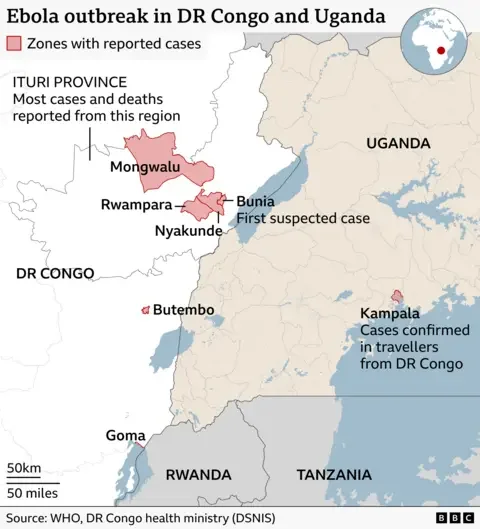
The World Health Organization (WHO) has escalated the public health risk of the ongoing Ebola outbreak in the Democratic Republic of Congo (DRC) to "very high," as the virus continues to spread across regional borders. The current epidemic, driven by the rare Bundibugyo strain, has resulted in approximately 750 suspected cases and 177 deaths in the DRC. In neighboring Uganda, the health ministry has confirmed new cases—including a driver, a health worker, and a traveler from the DRC—bringing that country's total to five. Unlike the more common Zaire strain, the Bundibugyo species currently has no proven vaccine or specific treatment, leading the WHO to declare the situation a public health emergency of international concern.
In a massive effort to bolster containment, the United Nations has authorized the immediate release of $60 million from its Central Emergency Response Fund (CERF). This allocation is specifically earmarked for high-priority medical interventions, including contact tracing, the establishment of specialized treatment centers, and the rapid deployment of medical supplies. Crucially, the UN has emphasized that these funds will bypass administrative overhead to support field teams directly. A major focus of the financial package is community engagement, aiming to build local trust and provide resources to community leaders for public education to counteract misinformation and skepticism that have hampered previous response efforts.
Despite the influx of financial aid, health authorities face severe operational challenges on the ground in the DRC. Incident managers report that hospitals are struggling to isolate suspected patients, who often mix with the general population, significantly increasing the risk of hospital-based transmission. The response has been further complicated by deep-seated community resistance, particularly regarding traditional burial practices that conflict with safe health protocols. In some instances, this distrust has turned violent; relatives of patients have reportedly set fire to treatment centers after health workers refused to release contaminated bodies for traditional interment. This insecurity, combined with general regional unrest, has hindered the ability of medical teams to reach remote areas and monitor transmission data effectively.
Looking ahead, scientists are racing to develop medical countermeasures to prevent the outbreak from escalating further. Researchers at Oxford University are currently testing a new vaccine candidate based on the technology used in the AstraZeneca COVID-19 vaccine, with animal testing underway and clinical trials potentially starting in the coming months. In the interim, Uganda has implemented strict border controls and suspended public transport in affected regions to manage the risk. While the WHO maintains that the global risk remains "low," they warn that total eradication will require sustained regional collaboration, cross-border monitoring, and a unified response from all neighboring health ministries to prevent the virus from gaining a wider foothold in Central Africa.
This story touches markets covered on Anansi Intelligence ↗.
More from africa
Continue exploring similar stories


