••
Vice President Opoku-Agyemang Advocates for Informal Workers as Unions Threaten Industrial Action
•3 min read•6 sources
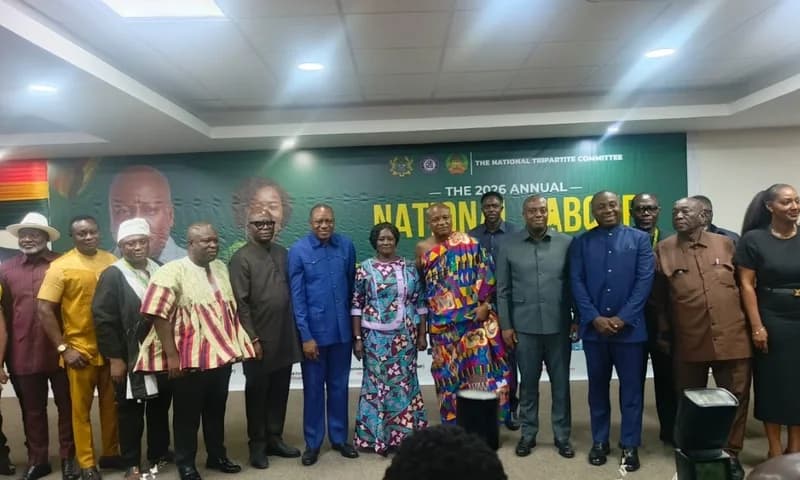
The 2026 National Labour Conference in Ho has emerged as a pivotal moment for Ghana’s labor landscape, with Vice President Prof. Jane Naana Opoku-Agyemang leading a call for the comprehensive protection of the country’s informal sector. Addressing stakeholders under the theme "Strengthening Industrial Harmony as a Catalyst for Accelerated Economic Growth and National Development," the Vice President highlighted a significant gap in the nation’s legal framework, noting that 78% of the workforce operates in the informal sector with inadequate labor rights. This push for reform comes at a volatile time, as the Trades Union Congress (TUC) and the Public Services Workers’ Union (PSWU) concurrently issued warnings of potential strikes over wage inequalities and delayed allowances.
During her keynote address, Prof. Opoku-Agyemang emphasized that the exclusion of informal workers—particularly women and the urban poor—from existing labor protections hinders sustainable economic development. To address this, the government is championing the Labour Bill of 2026, which aims to modernize labor administration and integrate the concerns of informal workers into national policy. Dr. Abdul-Rashid Pelpuo, the Minister for Labour, Jobs, and Employment, reinforced this commitment, noting that the Ghana Decent Work Country Programme (2026–2030) would be instrumental in expanding employment protections and adapting to contemporary workplace challenges, including the rise of artificial intelligence and shifting global economic dynamics.
However, the government’s vision for industrial harmony faces immediate pressure from organized labor. Joshua Ansah, General Secretary of the TUC, warned that the union is prepared to strike if the government fails to rectify alleged unequal public sector salary adjustments, urging for fairness in salary administration. Adding to the tension, the Public Services Workers’ Union (PSWU) has set a hard deadline of June 30, 2026, for the Fair Wages and Salaries Commission (FWSC) to release agreed-upon Institution Specific Allowances. The union expressed deep frustration over delays following an agreement finalized in March 2026, signaling that industrial peace is contingent on the prompt fulfillment of financial commitments.
Beyond immediate labor disputes, the conference also served as a platform for innovative proposals aimed at long-term worker welfare. Dr. Nana Dr. Emmanuel Adu-Sarkodee Afriyie, President of the Ghana Employers’ Association, proposed a National Homeownership Programme to address the country’s housing deficit and create jobs, which he argued would significantly enhance worker productivity. Supporting this call for institutional evolution, Dr. Vanessa Lerato Phala of the International Labour Organization (ILO) urged for the inclusion of informal workers in all policy discussions. The summit concluded with a consensus that while legislative reforms like the Labour Bill of 2026 are vital, the immediate restoration of trust through fair compensation and transparent dialogue remains the primary hurdle for national development.
This story touches markets covered on Anansi Intelligence ↗.
More from politics
Continue exploring similar stories


