••
President Mahama Leads Post-Flood Clean-Up as Minority Demands National Mourning and Long-Term Sanitation Policy
•3 min read•26 sources
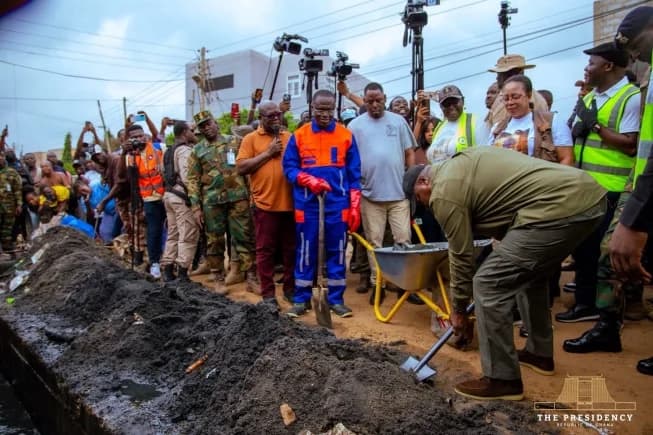
Following the devastating floods of June 29 that claimed approximately 30 lives and caused extensive property damage in Accra, President John Dramani Mahama has spearheaded a high-profile two-day National General Cleaning Exercise. The initiative, which saw active participation from the President and Vice President Professor Jane Naana Opoku-Agyemang on July 10 and 11, aimed to restore sanitation and clear debris across seven regions. To bolster these efforts, President Mahama ordered the immediate operationalization of six previously idle waste transfer stations managed by Zoomlion Ghana Limited in the Greater Accra Region, located in Achimota, Teshie, Kpone, Ashaiman, Pantang, and Adipa. While advocacy groups like AfriSAFE have praised the leadership shown during the exercise, the government faces mounting political pressure to move beyond temporary measures and address the systemic causes of urban flooding.
Minority Leader Alexander Afenyo-Markin has been vocal in his criticism, labeling the two-day clean-up a "short-term fix" that fails to address underlying infrastructure deficits. During parliamentary proceedings on July 14, Afenyo-Markin urged the government to implement a comprehensive national sanitation policy focused on drainage and flood prevention. He also called for a formal period of national mourning to honor the victims of the June 29 disaster, criticizing the lack of an official national address and noting an inconsistency in the government’s response compared to previous tragedies. Complementing this call for accountability, the Minority has demanded separate ministerial briefings on the sustainability of the cleaning initiatives and the performance of the national team in the recent World Cup.
On the operational front, the government has mobilized the military to assist in desilting drains and clearing waste to prevent disease outbreaks, with Deputy Minister for Defence Ernest Brogya Genfi emphasizing the necessity of logistical support from the private sector. Simultaneously, a strict enforcement of land-use regulations is underway. TDC Ghana Limited is set to begin demolishing illegal structures on the Sakumono Ramsar Site on July 15 to protect ecologically sensitive wetlands, while Ashanti Regional Minister Dr. Frank Amoakohene has ordered similar demolitions in Kumasi, targeting structures obstructing waterways. These actions are supported by environmental specialists like Dr. Kofi Anokye, who advocates for criminalizing the sale of unplanned land to prevent future obstructions of drainage systems.
Beyond immediate recovery, national leaders are emphasizing long-term climate resilience and international engagement. Vice President Opoku-Agyemang has called for Ghana to strengthen its role in international climate negotiations to secure global financing, noting Africa's vulnerability despite low emissions. In a similar vein, Speaker of Parliament Alban Bagbin has pledged support for climate resilience initiatives aimed at empowering rural women through sustainable shea production. As the nation grapples with the aftermath of the floods, the political discourse has shifted toward a dual-track approach: immediate structural enforcement and waste management, paired with a robust national policy framework to mitigate the impacts of the global climate crisis on Ghana’s urban and rural populations.
This story touches markets covered on Anansi Intelligence ↗.
Related topic
John Mahama: Latest News & Updates →More from politics
Continue exploring similar stories


