••
Minority Leader Afenyo-Markin Demands National Sanitation Policy and Official Mourning Following Deadly Accra Floods
•3 min read•26 sources
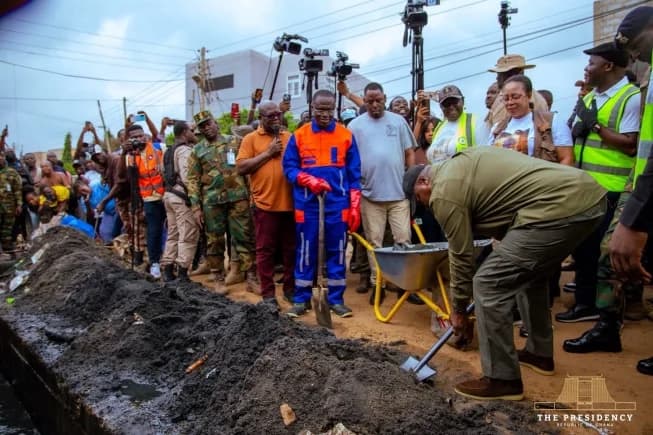
Following the devastating floods on June 29 that claimed approximately 30 lives and caused extensive property damage across Accra, political tensions have escalated regarding the government's long-term disaster management strategy. Minority Leader Alexander Kwamena Afenyo-Markin has formally called on the government to declare a period of national mourning to honor the victims, criticizing the lack of a formal state address. He argued that the government’s response has been inconsistent compared to previous disasters and urged the implementation of a comprehensive National Sanitation Policy. Afenyo-Markin dismissed the recent two-day national cleanup exercise as a temporary fix, insisting that sustainable drainage systems and coordinated flood prevention measures are the only ways to avert future tragedies.
In response to the crisis, President John Dramani Mahama and Vice President Professor Jane Naana Opoku-Agyemang led a two-day National General Cleaning Exercise on July 10 and 11. To facilitate the massive waste removal effort, President Mahama ordered the immediate activation of six previously idle waste transfer stations managed by Zoomlion Ghana Limited in Achimota, Teshie, Kpone, Ashaiman, Pantang, and Adipa. The Deputy Minister for Defence, Ernest Brogya Genfi, confirmed that the military has been fully mobilized to assist in desilting drains and clearing debris to prevent disease outbreaks. While the pan-African advocacy group AfriSAFE commended the President's hands-on leadership, critics like Lamtiig A. Apanga of the Gaming Commission slammed Dr. Mahamudu Bawumia for his absence, characterizing it as a failure of leadership during a national emergency.
The cleanup exercise also sparked industrial and legal friction. The Ghana Association of Banks (GAB) issued a strong rebuke to Okaikwei North MP Theresa Lardi Awuni after she reportedly confronted staff at a CalBank branch for remaining open during the cleanup. GAB clarified that banks provide essential services and are not legally required to shut down for such exercises. Meanwhile, in Kumasi, the Metropolitan Assembly (KMA) has taken steps to improve sanitation welfare by increasing street sweepers' monthly wages from GH₵250 to GH₵800, following an investigation into previous contracts. This shift toward direct funding from Internally Generated Funds reflects a growing trend of municipal authorities seeking more efficient, localized waste management models.
Broader discussions on national stability and democracy were also held at the Ghana Media Summit, where experts emphasized that physical infrastructure is only one part of a resilient nation. Media professionals and scholars argued for sustainable financing for journalism to combat disinformation and protect democratic integrity in West Africa. As the Kpone Katamanso Municipal Assembly considers decommissioning the overflowing Kpone landfill due to public health risks, the consensus across political and social sectors remains focused on the urgent need for structural reforms. Whether through ministerial briefings on sanitation sustainability or the call for ethical journalism, the current discourse highlights a critical demand for accountability and long-term planning in Ghana's public life.
This story touches markets covered on Anansi Intelligence ↗.
Related topic
John Mahama: Latest News & Updates →More from politics
Continue exploring similar stories


