••
President Mahama Orders Probe into GH¢73bn 'Big Push' Contracts as Ghana Tightens Fiscal and Procurement Controls
•3 min read•36 sources
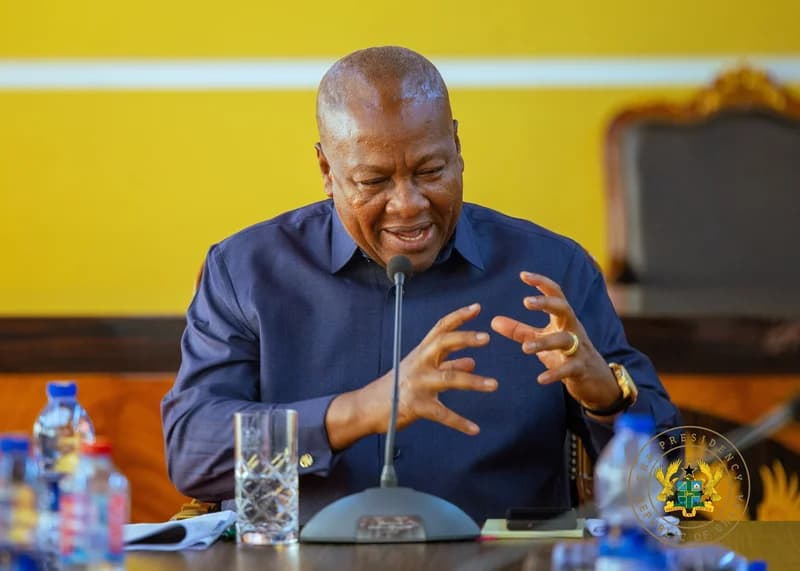
President John Dramani Mahama has directed his office to obtain a comprehensive investigative report from The Fourth Estate regarding the 'Big Push' road projects, following allegations of significant procurement irregularities. The report claims that Minister for Roads and Highways, Kwame Governs Agbodza, oversaw the awarding of 81 sole-sourced contracts valued at over GH¢73 billion within a seven-month period. During a dialogue with Civil Society Organizations (CSOs) at Jubilee House, President Mahama underscored the necessity of transparent, competitive tenders to ensure value for money. He announced plans to amend the Public Procurement Act to limit the use of sole sourcing and has tasked the Ministry of Finance with establishing an Independent Value for Money Office to oversee single-source procurements.
Adding to the government's reform agenda, Finance Minister Dr. Cassiel Ato Forson has announced the introduction of a new Loans Act. This legislation is designed to enhance fiscal discipline by ensuring that all future public borrowing is strictly tied to high-impact, value-for-money investments. The move follows the signing of Ghana’s 11th bilateral debt restructuring agreement with the Export-Import Bank of India. While the government emphasizes these reforms as a path to debt sustainability, the National Democratic Congress (NDC) has clarified through spokesperson Sammy Gyamfi that it does not intend to abolish sole sourcing entirely, but rather to curb its abuse and ensure its application is reserved for exceptional circumstances.
In Parliament, the Public Accounts Committee (PAC) has seen heated sessions involving Ketu North MP Eric Edem Agbana and committee leadership. These clashes centered on allegations that grain distribution from national warehouses was disrupted by "party people" following the 2024 elections. While Deputy Minister for Agriculture John Dumelo clarified that the individuals involved were regular citizens, the committee successfully facilitated a GH¢19.1 million refund from Rans Logistics after the Auditor-General flagged overpayments in grain transport. Further scrutiny revealed asset management lapses at the Ministry of Trade, where 47 air conditioners and 16 chairs were reportedly issued without proper documentation, prompting calls for stricter internal controls.
Broader accountability issues continue to stir political debate, particularly regarding the Gold-for-Reserves program and the extradition of former Finance Minister Ken Ofori-Atta. The Majority side of Parliament recently blocked an inquiry into the Gold-for-Reserves program, a decision former Information Minister Kojo Oppong Nkrumah labeled as a setback for oversight, citing a reported $214 million loss in 2025. Regarding Ken Ofori-Atta, President Mahama stated that he cannot interfere with the legal proceedings currently under U.S. jurisdiction, where Ofori-Atta is contesting Ghana's extradition request linked to corruption allegations from his 2017-2024 tenure.
Finally, the government is navigating challenges in the mining and trade sectors. The Minerals Income Investment Fund (MIIF) reported a record mineral royalty inflow of GH¢5.43 billion, yet stakeholders like the Media Coalition Against Illegal Mining are demanding more resources for the National Inter-Ministerial Committee on Small-Scale Mining (NAIMOS) to combat galamsey. Meanwhile, the Freight Forwarders Association of Ghana has initiated legal action against the Ministry of Finance, alleging that the implementation of the Publican AI system for customs valuation violates the Customs Act and lacks transparency. These converging developments highlight a period of intense scrutiny over public funds and the legal frameworks governing Ghana's economic and natural resources.
This story touches markets covered on Anansi Intelligence ↗.
Related topic
NDC (National Democratic Congress): Latest News →Live rates
Ghana gold price →More from politics
Continue exploring similar stories


