••
Ghana’s Industrial Shift Gains Momentum as Non-Traditional Exports Hit $5 Billion Amid New Investment and Agricultural Strategies
•3 min read•13 sources
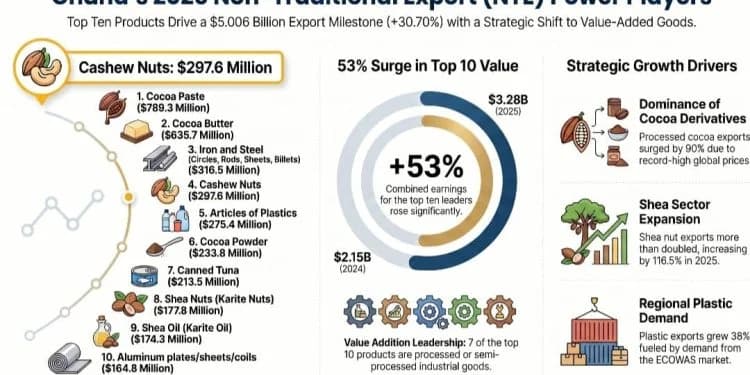
Ghana is witnessing a transformative shift in its economic landscape, driven by a record-breaking surge in Non-Traditional Exports (NTEs) and a renewed focus on value addition. According to latest data from the Ghana Export Promotion Authority (GEPA), total NTE earnings climbed to $5.006 billion in 2025, marking a 30.7% increase from the previous year. This growth is anchored by a historic 53% rise in the earnings of the country’s top ten non-traditional products, which reached $3.28 billion. Leading this charge is cocoa paste, which generated $789.3 million, signaling a successful departure from raw commodity dependence toward high-value processed goods. Manufactured and semi-processed goods now account for over 83% of total export earnings, reflecting a robust move toward national industrialization.
The cocoa sector’s evolution into a processed goods powerhouse is further evidenced by the strong performance of cocoa butter and cocoa powder. Beyond cocoa, the diversification strategy is yielding dividends in other sectors; shea nuts experienced a staggering 116.51% growth, while cashew nuts contributed $297.6 million to the national coffers. While traditional markets like the Netherlands, the United Kingdom, and France remain the primary destinations for these exports, there is a steady growth in intra-African trade within the ECOWAS sub-region. This resilience is particularly notable as it helps buffer the Ghanaian economy against the volatility of global raw material prices, despite minor declines in the iron and steel sectors due to price fluctuations.
To sustain this momentum, the Bank of Ghana is exploring innovative ways to mobilize "patient capital" through the diaspora. Governor Dr. Johnson Pandit Asiama recently hosted the "Central Bank Bridge: Remit2Invest" dialogue in Virginia, USA. This initiative aims to transform remittance inflows into long-term investment capital rather than just consumption-based transfers. By engaging Ghanaian professionals abroad and key financial institutions, the central bank seeks to create structured financial instruments that allow the diaspora to invest directly into critical economic sectors, further deepening financial inclusion and supporting the country’s industrial goals.
Complementing these export and investment gains, a significant agricultural transformation plan has been unveiled to boost food security and foreign exchange. Under the "Feed Ghana Programme," the strategy focuses on turning maize and rice production into large-scale export industries. The plan prioritizes processing and storage over primary production, with scheduled investments in five new maize processing plants and expanded rice milling capacities. By prioritizing private sector participation and agro-industrialization, these integrated efforts—spanning export diversification, diaspora investment, and agricultural processing—are positioning Ghana to build a more stable and self-reliant economy for the future.
This story touches markets covered on Anansi Intelligence ↗.
Live rates
Dollar to cedi rate →More from business
Continue exploring similar stories

