••
Ghana Accelerates Economic Transformation: Massive Industrial Investments and Trade Reforms Take Center Stage
•3 min read•18 sources
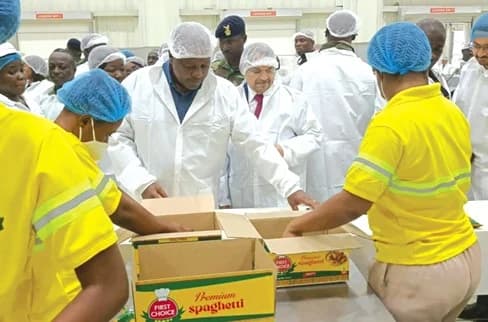
Ghana’s industrial landscape is undergoing a significant shift as the government and private sector collaborate to bolster local manufacturing and job creation. President John Dramani Mahama recently commissioned the world’s largest calcined clay cement plant in Tema, a $110-million facility operated by CBI Ghana Limited. The plant aims to reach 1.5 million tonnes of cement annually, utilizing locally sourced clay to reduce reliance on imported clinker and align with national climate commitments. This was complemented by the inauguration of Olam Agri Ghana’s new pasta manufacturing facility in Kpone, which boasts an initial capacity of 40,000 metric tonnes. These projects are central to the government’s 'Economic Reset Agenda,' which targets a 15% manufacturing share of GDP by 2030 and seeks to reduce dependency on imported processed foods through local agricultural integration.
Simultaneously, the 24-Hour Economy and Accelerated Export Development Secretariat has entered a landmark partnership with ATRI Energy Transition Private Limited. This Memorandum of Understanding (MoU) aims to create over 160,000 jobs within five years by developing renewable energy zones and solar parks capable of generating 2,000 megawatts. This initiative is echoed by global textile experts who urge the government to further support the garment sector, particularly facilities like Anowah Afrique Ltd. Experts argue that with the right automation and workforce training—focused on women and vulnerable youth—the garment industry could employ thousands more under a 24-hour shift system, leveraging Ghana’s favorable free trade agreements with the U.S. and Europe.
On the international front, Ghana is intensifying its trade diplomacy to improve market access for local businesses. At the Commonwealth Foreign Affairs Ministers Meeting in London, Foreign Minister Samuel Okudzeto Ablakwa called for the elimination of tariffs and trade barriers among member states to foster economic cooperation. To support this vision, the Ghana High Commission in London has opened an Export Trade House to boost the visibility of Ghanaian products and support SMEs in reaching UK markets. Domestically, however, trade efficiency remains a concern. Deputy Minister Sampson Ahi has tasked the National Trade Facilitation Committee with addressing port bottlenecks and clearing delays that impose financial burdens on exporters and importers, emphasizing the urgent need for faster movement of perishable goods.
Despite these industrial gains, the agricultural sector faces a complex set of challenges and opportunities. While cocoa farmers in Ghana and Ivory Coast are currently struggling with a global market crash and debt issues involving Cocobod, industry leaders are calling for structural reforms. Dr. Charles Nyaaba of the Peasant Farmers Association and Davies Korboe of the Federation of Ghanaian Exporters (FAGE) advocate for treating farming as a business rather than a social service. They recommend adopting 'push-pull' farming models—where nucleus farmers support smaller outgrowers—and improving mechanization and irrigation. As the country navigates these transitions, including a move toward e-mobility and major infrastructure rehabilitations like the N1 Highway, the focus remains on building a resilient, value-added economy that balances industrialization with rural agricultural stability.
This story touches markets covered on Anansi Intelligence ↗.
More from business
Continue exploring similar stories

