••
WHO Declares Ebola Outbreak a Global Health Emergency as Cases Rise in DR Congo and Uganda
•2 min read•9 sources
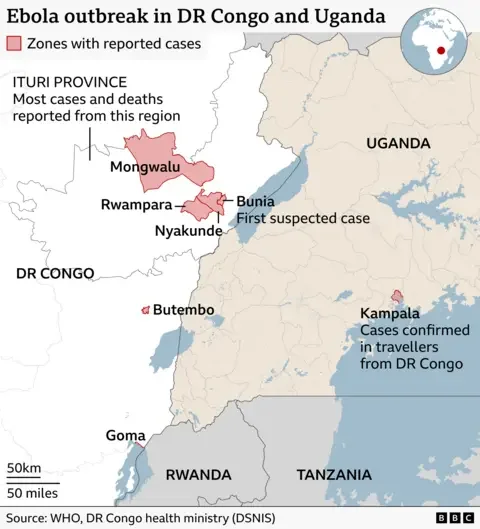
The World Health Organization (WHO) has declared the current Ebola outbreak in the Democratic Republic of Congo (DRC) a Public Health Emergency of International Concern (PHEIC) as the death toll approaches 140. Centered primarily in the Ituri and North Kivu provinces, the outbreak is driven by the rare Bundibugyo strain, which is significantly more difficult to diagnose than the more common Zaïre variant. With suspected cases nearing 600 and the virus officially crossing the border into Uganda, regional health authorities are on high alert to contain the spread of the deadly disease.
The crisis is severely exacerbated by ongoing armed conflict and a humanitarian emergency in eastern DRC, where over 100,000 individuals have been displaced. Health officials warn that the virus may be spreading faster than initial reports suggest, with WHO investigators estimating that the actual number of infections could exceed 1,000 due to under-detection and unreported community deaths. In neighboring Uganda, authorities have quarantined over 100 individuals to prevent a wider outbreak following two confirmed cases. The situation is further complicated by the lack of an approved vaccine or specific drug treatment for the Bundibugyo species, forcing medical teams to rely on traditional containment and supportive care.
In response to the escalating regional risk, neighboring countries are tightening their defenses. Rwandan authorities have intensified border screenings and temperature checks, while in West Africa, Ghana’s Ministry of Health has urged the public to remain vigilant and maintain strict hand hygiene protocols despite no reported cases in that region. The international community has mobilized support, with the United States pledging $13 million in emergency assistance and the WHO delivering 12 tonnes of medical equipment and 40 experts to the epicenter in Bunia. A Level 4 travel advisory has also been issued by the U.S. for the affected provinces to discourage non-essential travel.
WHO Director-General Tedros Adhanom Ghebreyesus has emphasized that while the global risk remains low, the regional threat is high due to the potential for urban spread and the deaths of several frontline health workers. Moving forward, health officials are focusing on intensifying surveillance, ensuring the availability of handwashing facilities at public events, and combating misinformation to ensure local communities cooperate with medical guidelines. The success of the response will depend on navigating the complex security environment and providing adequate resources to overstretched healthcare facilities in the region.
This story touches markets covered on Anansi Intelligence ↗.
More from africa
Continue exploring similar stories


