••
Continental Progress: Africa Navigates Sports Diplomacy, Global Migration Policies, and Regional Cooperation
•3 min read•6 sources
The African continent is currently navigating a complex landscape defined by sports governance, international diplomacy, and cross-border cooperation. In a significant development for football enthusiasts, the United States has announced a waiver of the controversial visa bond for fans from five African nations—Algeria, Cape Verde, Ivory Coast, Senegal, and Tunisia—traveling to the 2026 FIFA World Cup. This move, which removes a potential financial burden of up to $15,000 for ticket holders who register with the FIFA Pass system by April 15, comes as a relief to supporters from a continent that will see a record ten teams participate in the upcoming tournament. However, experts note that significant hurdles remain, including travel bans for certain countries, rising costs, and potential social media screening policies.
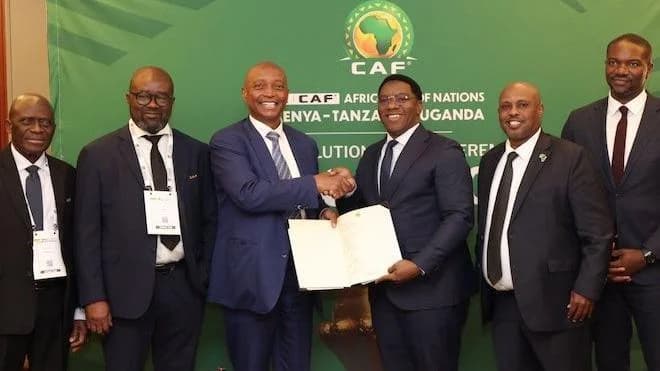
Simultaneously, the Confederation of African Football (CAF) is working to resolve the fallout from the 2025 Africa Cup of Nations (AFCON) final in Morocco. CAF President Patrice Motsepe has acknowledged "deficiencies" that led to a chaotic conclusion, where Senegal was stripped of its title following a walk-off protest over a controversial penalty decision. As Senegal’s Football Federation challenges the ruling at the Court of Arbitration for Sport, Motsepe is conducting a diplomatic mission to reconcile with member nations and restore the reputational standing of African football. These efforts are critical as preparations begin for the 2027 AFCON, which will be co-hosted by Kenya, Tanzania, and Uganda, despite ongoing governance and stadium readiness concerns in the region.
Beyond the sporting arena, African leadership is actively engaging in high-level international and regional institutional exchanges. Amb. Dr. Samuel Ben Owusu, the West Africa Head of Mission for the AU Agenda 2063, recently represented the continent at the 11th Annual UN Multi-Stakeholder Forum on Science, Technology, and Innovation in New York. His contributions focused on inclusive digital transformation, AI governance, and the vital link between technology and water security. These global discussions are being mirrored by practical regional collaborations, such as a recent study tour by a Nigerian Correctional Service delegation to Ghana’s Ankaful Prison Complex. Led by Assistant Controller General Lakatile Cyrus Cham, the visit focused on sharing best practices in inmate management and rehabilitation, highlighting a shared commitment to strengthening correctional administration.
These diverse developments underscore a period of active reform and strategic planning across Africa. Whether through the easing of travel restrictions for global events, the rectification of officiating standards within CAF, or the pursuit of sustainable development goals via technology and inter-state learning, the continent is asserting its influence on the global stage. As Ghana prepares for upcoming leadership summits on peace and water security, and as sporting bodies refine their regulations, the focus remains on building resilient institutions capable of navigating both local administrative challenges and broader international pressures.
This story touches markets covered on Anansi Intelligence ↗.
More from africa
Continue exploring similar stories


