••
Philippines Earthquake: 19 Dead and Over 200 Injured Following 7.8 Magnitude Tremor in Mindanao
•2 min read•7 sources
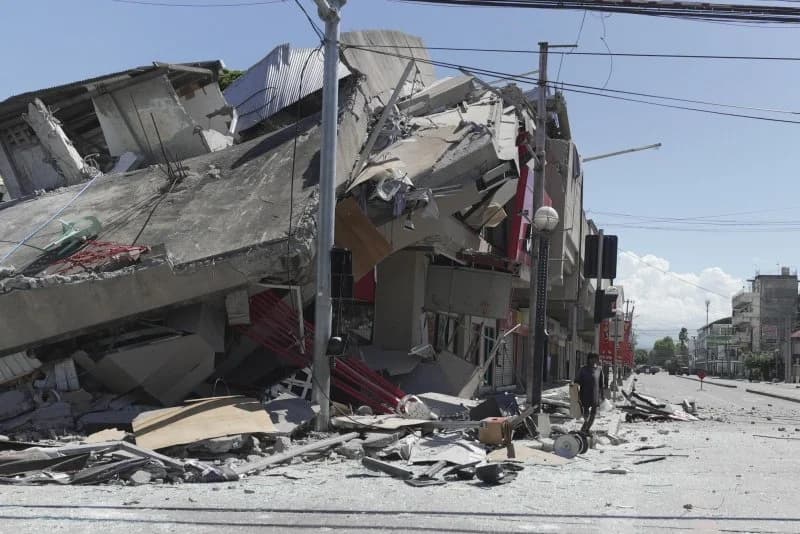
A powerful magnitude-7.8 earthquake struck off the coast of Mindanao in the southern Philippines on a Monday morning, leaving a trail of destruction that has claimed at least 19 lives and injured over 200 people. The seismic event occurred at 07:37 local time at a depth of approximately 35 kilometers, with its epicenter located southwest of Maasim town. The tremor was felt across the region, triggering immediate panic and leading to the mobilization of emergency services across several provinces. Initial reports suggest that the death toll may continue to rise as rescue teams reach more isolated areas.
The port city of General Santos bore the brunt of the disaster, reporting significant infrastructure damage and multiple fatalities. Search and rescue teams have been deployed to work through the rubble of collapsed structures, which include a popular Jollibee restaurant and sections of a multi-story office building. Local authorities were forced to temporarily shut down the city’s airport for safety assessments, while widespread power outages hampered initial communication and rescue efforts. Disaster management officials, including chief Agripino Dacera, noted that ground assessments are ongoing to verify the full extent of the casualties and structural loss.
The timing of the quake added a layer of complexity to the emergency, as it coincided with the first day of the new school year. Thousands of students were gathered for morning activities when the ground began to shake, resulting in stampedes and injuries as children fled classrooms in panic. Beyond the initial shock, the region has been rocked by more than 130 aftershocks, some reaching a magnitude of 6.7. Tsunami warnings were also issued shortly after the quake, prompting the evacuation of thousands of residents from coastal communities, though a major tsunami threat did not ultimately materialize.
In response to the crisis, President Ferdinand Marcos Jr. ordered the immediate suspension of classes in all affected areas and directed national agencies to provide comprehensive support for recovery operations. This latest disaster underscores the Philippines' constant vulnerability to seismic activity, situated as it is along the Pacific "Ring of Fire." As assessments continue and rescue teams reach remote villages, the government is focusing on providing medical aid and restoring essential services to the displaced population, highlighting the urgent need for reinforced infrastructure in one of the world's most earthquake-prone regions.