••
President Mahama Signs Landmark Legislation, Probes Procurement Concerns, and Launches Major Health Reform
•3 min read•46 sources
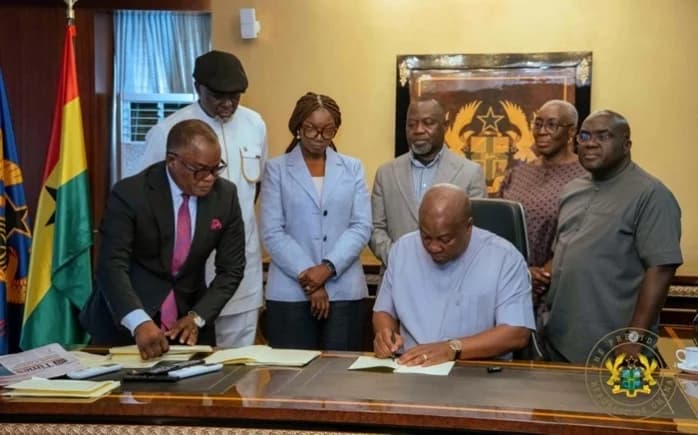
In a flurry of executive action at the Jubilee House, President John Dramani Mahama has signed five significant bills into law and announced the official launch of the Free Primary Healthcare Programme for April 15, 2026. The newly assented laws include the Security and Intelligence Agencies Act, which restores the name of the National Intelligence Bureau (BNI) and reshapes oversight of security services, and the Growth and Sustainability Levy (Amendment) Act, which reduces the mining levy from 3% to 1%. Additionally, the President signed the University of Engineering and Agricultural Sciences Act, establishing a new multi-campus institution in the Eastern Region, and amended the Ghana Deposit Protection Act to extend financial safety nets to mobile money wallets and digital platforms. These legislative milestones are part of a broader government strategy to stabilize the economy, enhance national security, and modernize education.
Simultaneously, President Mahama engaged in a high-stakes dialogue with Civil Society Organizations (CSOs) to address mounting concerns regarding transparency and accountability. Central to these discussions was an order for the Ministry of Roads and Highways to respond to allegations of unmerited sole-sourcing in road contracts valued at GH"73 billion under the ‘Big Push’ infrastructure program. The President requested a full report from The Fourth Estate to guide further investigations, emphasizing his commitment to competitive pricing and a proposed amendment to the Public Procurement Act to limit single sourcing. During the same engagement, Mahama refrained from commenting on the pending extradition request for former Finance Minister Ken Ofori-Atta, noting that the case must proceed through the United States legal system while Ghana fulfills the necessary documentation requirements.
Social protection and human rights also took center stage as the government reaffirmed its commitment to vulnerable populations. The President urged the swift passage of the Anti-Witchcraft Bill to criminalize the abuse of elderly women and defended his call for slavery reparations, dismissing criticisms by likening the slave trade to the Holocaust. In parallel, the Ministry of Gender, Children and Social Protection launched the National Shock-Responsive Social Protection Strategy and announced the upcoming creation of a ‘Women’s Development Bank.’ This new financial institution aims to provide collateral-free loans and business development services to female entrepreneurs, who currently lead 44% of Ghana’s micro, small, and medium enterprises. The Ministry also conducted a comprehensive review of the National Plan of Action for the Elimination of Human Trafficking, prioritizing prevention and protection ahead of the 2026 FIFA World Cup.
On the economic and security front, the government is preparing to shield consumers from rising global fuel costs by potentially reviewing marketing margins and the one-cedi development levy. Addressing labor concerns, the President announced a decentralized, district-based recruitment system for teachers and health workers to curb urban migration and ensure rural staffing. This reform includes a review of security service recruitment fees after nearly 280,000 applicants vied for limited positions. As the first session of the ninth parliament concluded, Majority Leader Maham Ayariga lauded these executive and legislative efforts, particularly the passage of the 24-Hour Economy Authority Bill, as vital steps toward reducing youth unemployment and achieving national transformation. These combined initiatives reflect a government moving to balance rapid infrastructure development with rigorous institutional reform and social equity.
This story touches markets covered on Anansi Intelligence ↗.
Related topic
John Mahama: Latest News & Updates →Live rates
Dollar to cedi rate →More from politics
Continue exploring similar stories


