••
President Mahama Unveils Comprehensive Development Strategy Across Security, Energy, and Governance Sectors
•3 min read•23 sources
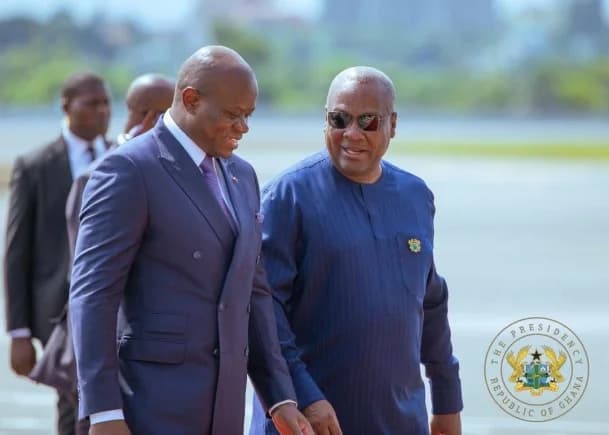
President John Dramani Mahama has launched an extensive series of national initiatives aimed at bolstering Ghana’s security, energy capacity, and executive accountability. Highlighting his security agenda, the President commissioned the new Odumase Krobo Divisional Police Headquarters at Laasi and announced the procurement of 40 additional armored vehicles for the Ghana Police Service. This move doubles the service's tactical mobility to 80 units, specifically targeting armed robbery and high-risk operations. President Mahama underscored that a modern, professional police force is essential for national stability, emphasizing that these investments are vital to protecting both officers and citizens in an increasingly complex security environment.
To ensure these and other national promises are fulfilled, Chief of Staff Julius Debrah has activated the Presidential Delivery Unit (PDU). This new internal compliance engine will conduct monthly reviews of government projects and presidential commitments to ensure they align with the administration's strategic vision. A key feature of the PDU is its decentralized approach, which includes engaging with traditional and community leaders to verify progress reports from regional appointees. This push for transparency is mirrored in the energy sector, where the President pledged to establish Phase Two of the Atuabo Gas Processing Plant. Backed by $3.5 billion in investments from Jubilee partners and ENI, the project is expected to boost electricity generation capacity to nearly 6,000 megawatts, addressing rising demand and facilitating potential energy exports.
On the social and international stage, the administration is focusing on gender equity and technological innovation. President Mahama has advocated for a law to criminalize the solicitation of romantic favors in exchange for employment, while committing to gender parity in public appointments by 2028. Internationally, the President joined global leaders in Gabon for the Libreville International Forum for Innovation and Development. This summit, which focused on the intersection of political stability and artificial intelligence, culminated in the "Libreville Declaration" to enhance digital integration across Africa. Domestic infrastructure also saw attention with a commitment to complete 1,250 beds in new hostel facilities at the University of Environment and Sustainable Development (UESD) by February 2027.
Despite these developments, the government faces significant criticism from the opposition and civil society. Minority Leader Alexander Afenyo-Markin has actively engaged in cultural diplomacy at the Aboakyir Festival, while NPP Member of Parliament Kojo Oppong Nkrumah argued that macroeconomic "stability of numbers" has failed to improve the livelihoods of citizens struggling with 34% youth unemployment. Furthermore, some political observers have called for a cabinet reshuffle by June to revitalize the administration. As the NDC’s Eric Offei urges support for the 2028 elections, the government’s ability to translate these high-level pledges into tangible economic relief will likely remain a central point of political contention.
This story touches markets covered on Anansi Intelligence ↗.
Related topic
NDC (National Democratic Congress): Latest News →More from politics
Continue exploring similar stories


