••
Mahama Leads Global Reparations Charge as Ghana Champions Economic Sovereignty and Honors Revolutionary Hero Sgt. Peter Tasiri
•3 min read•30 sources
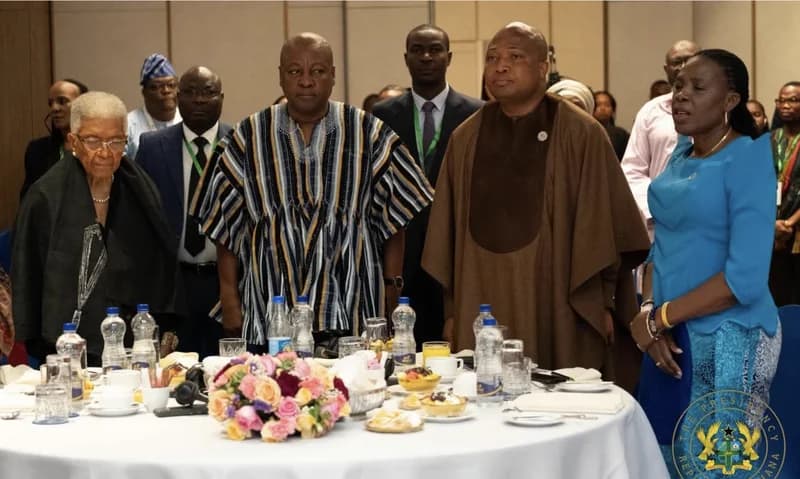
In a significant push for global justice and economic independence, President John Dramani Mahama is spearheading a landmark resolution to be presented to the United Nations General Assembly in March 2025. The resolution seeks formal global recognition of the Transatlantic Slave Trade as a grave crime against humanity. Acting in his capacity as the African Union (AU) Champion for Justice and Reparations, Mahama's initiative has already gained the formal adoption of the AU Assembly. This diplomatic move is part of a broader 'Year of Justice for Africans through Reparations' campaign, which aims to reshape the global narrative around historical injustices and establish national commissions across member states to engage historical perpetrator nations in formal dialogue.
Parallel to this international advocacy, the Ghanaian presidency has introduced the 'Accra Reset' initiative, a bold framework designed to enhance the nation’s economic sovereignty and transform its trade relationships. Key reforms include a commitment to end foreign cocoa financing by 2030, with plans to raise domestic bonds in Cedis to purchase cocoa directly from farmers. President Mahama has also pledged to halt the export of raw mineral ores by the same deadline, emphasizing local value addition and job creation. These measures, discussed during the AU Summit in Addis Ababa, are framed as essential steps to align Africa’s finance, health, and technology sectors while addressing the migration pressures facing the continent’s youth.
The drive for national identity and unity was further underscored by a recent cultural phenomenon dubbed the 'fugu fight.' After President Mahama wore a traditional Ghanaian smock (fugu) during a visit to Zambia, social media debates evolved into a nationwide celebration of Ghanaian heritage. This movement, supported by initiatives like 'Fugu Friday,' has not only fostered national pride but also created tangible economic opportunities for local weavers. Prominent voices, including Alhaji Seidu Agongo, have noted that this collective defense of cultural identity serves as a reminder of the power of unity in tackling broader national challenges such as poverty and educational reform.
While looking toward the future, Ghana is also reflecting on its revolutionary past following the passing of Sergeant Peter Tasiri Azongo on February 15, 2026. Aged 95, Sgt. Tasiri was a pivotal figure in the June 4, 1979 uprising, famously instrumental in releasing Flight Lieutenant Jerry John Rawlings from detention. The JJ Rawlings Foundation has paid tribute to his role in laying the foundation for Ghana’s socio-political transformation. His family, supported by the Foundation, has requested privacy as they seek a state burial for the man whose actions fundamentally altered the course of the nation's political history.
These converging developments—the pursuit of global reparations, the shift toward economic self-reliance, the celebration of cultural identity, and the honoring of historical icons—represent a multifaceted effort to redefine Ghana’s place in the world. As the nation prepares for the UN resolution in March and moves toward its 2030 economic targets, the synthesis of historical legacy and forward-looking policy suggests a strategic commitment to justice and sovereignty. The success of these initiatives will likely depend on maintaining the national unity recently displayed in the cultural arena to meet the ambitious goals of the 'Accra Reset' and the global reparations agenda.
This story touches markets covered on Anansi Intelligence ↗.
Related topic
John Mahama: Latest News & Updates →More from politics
Continue exploring similar stories


