••
President Mahama Outlines Comprehensive Industrial and Agricultural Reforms to Drive Ghana’s Economic Transformation
•3 min read•12 sources
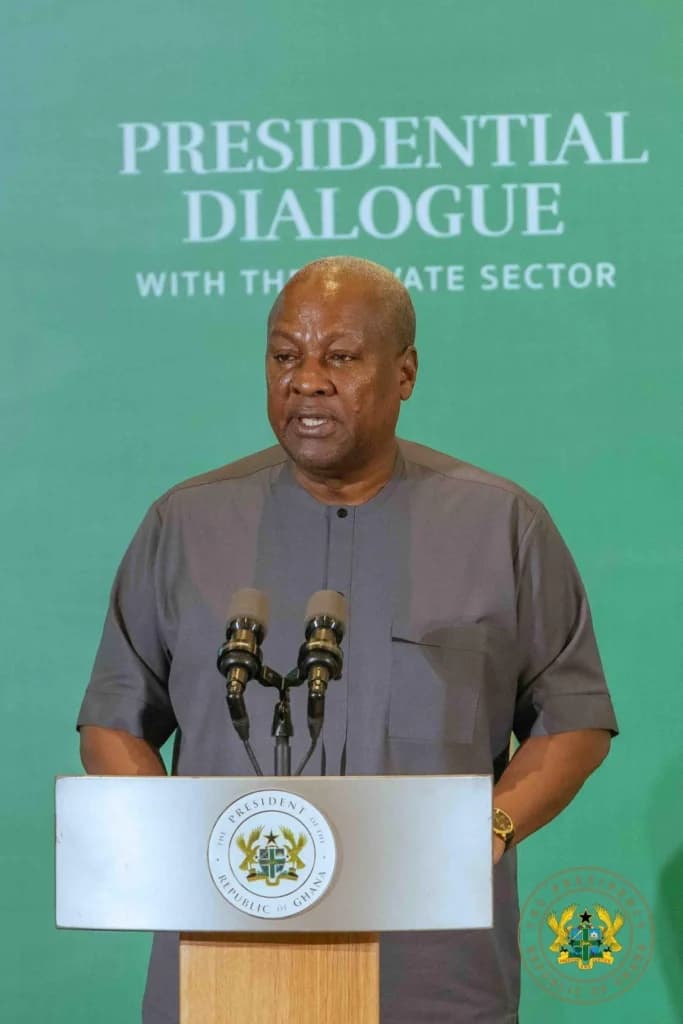
President John Dramani Mahama has unveiled a multi-faceted economic strategy aimed at revitalizing Ghana’s manufacturing and agricultural sectors. Speaking at a high-level Presidential Dialogue with the Private Sector in Accra, the President announced the imminent Cabinet approval of a National Agribusiness Policy and a series of structural reforms designed to transition the nation from a raw commodity exporter to a value-added industrial hub. These initiatives form a core part of the government’s industrial transformation agenda, seeking to address long-standing barriers to growth while fostering a more competitive environment for local businesses and international investors alike.
A cornerstone of this strategy is the new National Agribusiness Policy, which focuses on securing land tenure, fast-tracking the allocation of agro-industrial lands, and introducing commercial contract farming. To support this, the President highlighted plans to invest heavily in storage and cold chain infrastructure to curb post-harvest losses. Complementing these agricultural reforms is a revolutionary automatic cocoa pricing system. This new mechanism guarantees farmers 70% of the international market price, adjusted for exchange rates, thereby ensuring transparency and protecting farmers' earnings from administrative delays. By revamping local processing operations and shifting toward domestic funding for cocoa purchases, the government aims to modernize the sector and enhance its sustainability.
Addressing the stagnation of the manufacturing sector, which has remained at approximately 10% of GDP for decades, President Mahama set an ambitious target to increase this contribution to 15% by 2030, potentially creating 500,000 industrial jobs. To achieve this, the government plans to overhaul the water sector by involving private players in the supply of industrial water, ensuring that factories have the reliable resources needed for production. Furthermore, the President pledged to tackle high electricity tariffs and unstable power supply through energy debt restructuring and an expansion into renewable energy. By reducing corporate tax burdens and import duties on machinery, the administration hopes to position Ghana as a preeminent manufacturing hub within West Africa.
To protect these economic gains, President Mahama issued a stern warning against trade malpractice, declaring that smuggling, counterfeiting, and the diversion of goods would be treated as acts of economic sabotage. Following the recent interception of 18 trucks involved in revenue-evading schemes, the President vowed to prosecute offending public officials and strengthen border enforcement. These measures, integrated with the 24-Hour Economy programme, are intended to bolster Ghana's standing within the African Continental Free Trade Area (AfCFTA). The President concluded by urging the private sector to partner with the government in these endeavors, emphasizing that continuous dialogue and legitimate enterprise are the primary engines for national job creation and sustainable industrialization.
This story touches markets covered on Anansi Intelligence ↗.
Related topic
John Mahama: Latest News & Updates →More from politics
Continue exploring similar stories


