••
President Mahama Leads Nationwide Clean-Up Exercise to Combat Flooding and Revolutionize Ghana's Sanitation Culture
•3 min read•14 sources
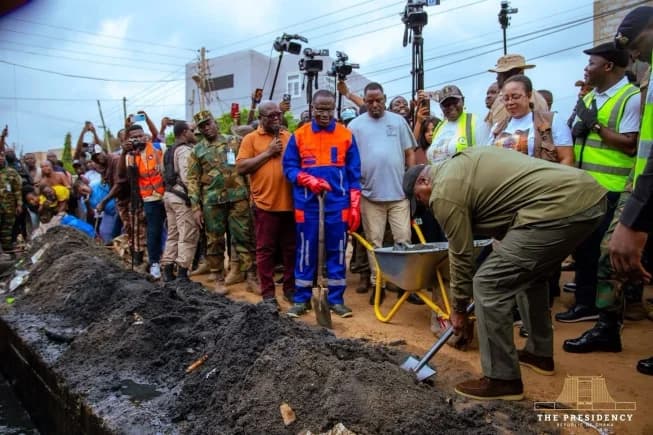
In a decisive response to recent devastating floods that have ravaged parts of the country, President John Dramani Mahama has spearheaded a massive nationwide clean-up exercise. The initiative, which saw significant turnout in the Greater Accra and Volta Regions, brought together security personnel, sanitation workers, and ordinary citizens in a collaborative effort to desilt choked drains and clear heaps of refuse. Concentrating on flood-prone areas such as the Kwame Nkrumah Circle, the central business district of Accra, and the Ho municipality, the exercise aims to mitigate immediate environmental hazards while signaling a renewed government focus on urban sanitation management.
The second day of the exercise saw an intensified focus on waste evacuation, with President Mahama urging those remaining at home to join the effort. Large trucks and personnel from the Ghana Armed Forces were deployed to ensure that waste removed from gutters was properly transported to disposal sites, addressing concerns about refuse being washed back into the drainage system. This communal spirit was bolstered by religious organizations, including the Assemblies of God, Ghana, which called on its members to view environmental stewardship as a vital expression of faith and civic duty. Local leaders in the Volta Region and beyond praised the high level of engagement, noting that the exercise provided a necessary platform for collective action against the perennial threat of flooding.
Despite the widespread participation, the exercise has sparked a national conversation about the sustainability of reactionary sanitation efforts. High-profile figures, including veteran musician Rex Omar and COCOBOD Deputy CEO Dr. Francis Baah, have called for a fundamental cultural shift, advocating for cleanliness to become a permanent lifestyle rather than a response to disaster. Musician Keche Joshua further suggested that such exercises should be made mandatory on a weekly basis. However, the initiative faced criticism from IMANI Africa Vice President Kofi Bentil, who observed that in some areas, mud removed from gutters was left on the streets, posing risks to motorists and pedestrians. He emphasized that without better organization and complete waste removal, such efforts might prove counterproductive.
To ensure the long-term success of the campaign, authorities have begun strict enforcement of environmental bylaws. The Afigya Kwabre South District Assembly recently summoned 17 individuals and institutions for various sanitation offenses uncovered during the exercise, signaling a zero-tolerance approach to illegal waste disposal. Regional ministers have further warned of the impending demolition of structures that obstruct waterways. As the nation moves forward, the consensus among leaders and participants alike is that while the clean-up exercise is a critical first step, only a combination of rigorous law enforcement, improved waste management infrastructure, and a sustained sense of civic responsibility will safeguard Ghana's communities against future environmental crises.
This story touches markets covered on Anansi Intelligence ↗.
More from africa
Continue exploring similar stories


