••
Ghana Advocates for Economic Shift: From International Trade Reforms to Local Budget Accountability
•3 min read•10 sources
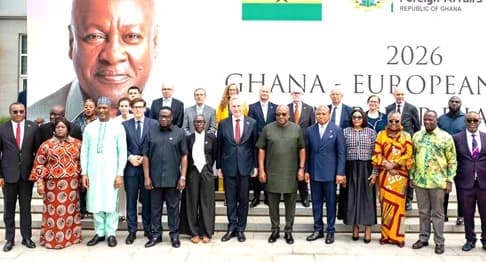
Ghana is navigating a strategic pivot toward economic self-reliance, emphasizing a transition from aid-dependence to robust trade and investment. During the Ghana-EU Partnership Dialogue, President John Dramani Mahama underscored the importance of strategic partnerships rooted in mutual respect, highlighting the government’s "24-Hour Economy" initiative as a cornerstone of national recovery. This vision is mirrored at the regional level, where Trade Minister Elizabeth Ofosu-Adjare recently led ECOWAS Ministers on a tour of Kasapreko Company. The delegation called for the urgent removal of non-tariff barriers and administrative delays to foster intra-regional trade, positioning local manufacturing as a primary engine for West African economic integration and job creation.
Complementing these high-level trade initiatives are significant infrastructure investments designed to boost local commerce. In the Ellembelle District, Member of Parliament Emmanuel Armah-Kofi Buah announced that the GH¢9 million Esiama market complex is 80% complete and set for a September 2026 commissioning. Funded by the Ghana National Gas Company Limited, the facility will feature 76 stores and a dedicated transport terminal. By relocating operators from the Elubo-Agona Nkwanta highway to this new commercial hub, the project aims to reduce traffic congestion and enhance safety, providing a structured environment for local economic activity to flourish.
However, the drive for economic growth is facing scrutiny at the grassroots level, where the Peasant Farmers Association of Ghana (PFAG) is demanding greater budget accountability. Through training programs supported by the Star Ghana Foundation, Multi-Stakeholder Platforms (MSPs) in the Chereponi and Daffiama-Bussie-Issa (DBI) districts have identified a sharp disconnect between local demographics and fiscal priorities. In Chereponi, budget analysis by Dr. Benjamin Sarfo revealed that while agriculture employs 81% of the population, it receives a mere 1.81% of the district budget. A similar trend was observed in the DBI District, where the sector received only 8.8% of the allocation despite its vital role in the local economy.
To bridge this gap, PFAG is equipping local stakeholders, including civil society organizations and district assembly representatives, with advocacy tools to influence future planning. Dr. Roger Akanbisik and other experts have emphasized the importance of safeguarding vulnerable groups and ensuring that farmers' voices are represented in decision-making processes. As Ghana seeks to industrialize and expand its trade footprint, these efforts at the district level highlight the necessity of aligning local government spending with the nation’s broader agricultural and economic priorities. The commitment from these stakeholders suggests a growing movement toward evidence-based advocacy to ensure that those driving the economy are not left behind in the budget process.
This story touches markets covered on Anansi Intelligence ↗.
More from politics
Continue exploring similar stories


