••

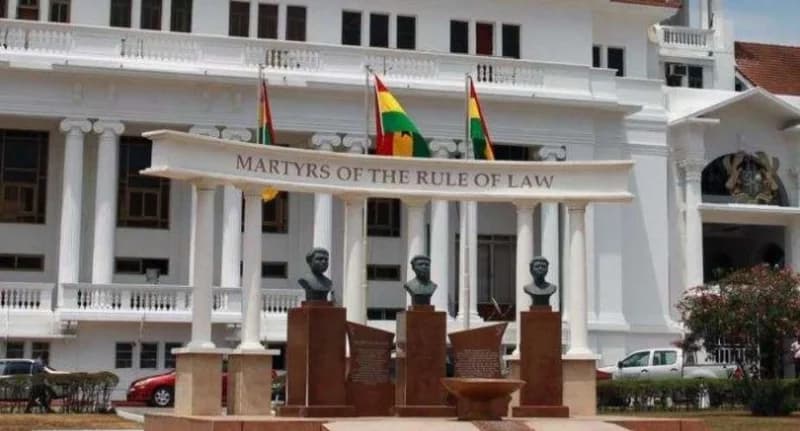
The Supreme Court of Ghana has been petitioned to provide a definitive interpretation of Article 66(2) of the 1992 Constitution, a move that could fundamentally alter the country’s presidential landscape. Two separate lawsuits, filed by lawyer and news editor Kenneth Kwabena Agyei Kuranchie and a teacher named Ganiwu Alhassan, argue that the current two-term limit may only apply to consecutive terms rather than serving as a lifetime cap. The legal actions, initiated between late June and July 2026, seek to clarify whether an individual who has already served two terms could be eligible to run for office again after a break in service. This interpretation is particularly relevant to the political trajectory of President John Dramani Mahama, whose eligibility for future terms remains a point of intense public scrutiny.
Ganiwu Alhassan’s suit specifically challenges the traditional reading of the constitution, suggesting that the document’s intent does not impose a permanent disqualification for non-continuous terms. He argues that the democratic rights of citizens should allow for the re-election of former leaders if their terms are not served back-to-back, claiming that the Constitution does not explicitly mandate a lifetime ban. Similarly, Ken Kuranchie has filed a writ against the Attorney General seeking a clear declaration on these provisions. These filings have reignited a national debate over the spirit of the 1992 Constitution and whether the framers intended to prevent the consolidation of power through a strict two-term lifetime limit or merely a limit on consecutive incumbency.
The legal maneuvers have drawn sharp warnings from across the political spectrum. Sammi Awuku, the Member of Parliament for Akuapem North, has cautioned President Mahama to avoid what he describes as a "political trap." Awuku suggested that any attempt to utilize these legal loopholes to extend his presidency could damage Mahama's political legacy, unite the opposition, and trigger internal friction within the National Democratic Congress (NDC). He urged the President to complete his current term and retire with dignity in 2029. Richard Ahiagbah, the National Communications Director of the NPP, echoed these sentiments, asserting that the country is not prepared for a "third-term agenda" and labeling the legal efforts a "dead end" that ignores public sentiment.
Legal and civic experts have also called for the Supreme Court to exercise caution. Professor Henry Kwasi Prempeh, Executive Director of CDD-Ghana and Chairman of the Constitutional Review Committee, has urged the court to dismiss the lawsuits outright. Prof. Prempeh argued that the court’s jurisdiction should not be invoked for hypothetical scenarios where no actual legal dispute exists, emphasizing that the judiciary should not be used to address academic questions. Furthermore, NPP stalwart Gabby Asare Otchere-Darko dismissed the claims, illustrating how such interpretations could lead to improbable scenarios, such as former leaders contesting elections decades after their initial service.
As the Supreme Court prepares to hear these landmark cases, the outcome remains a focal point for Ghana’s democratic stability. While the plaintiffs argue for a more flexible interpretation of executive eligibility to protect the rights of candidates and voters, critics maintain that any deviation from the established two-term limit threatens the rotational power dynamics that have defined the Fourth Republic. The eventual ruling will serve as a crucial test of the judiciary’s role in interpreting the nation’s foundational legal framework and will likely shape the strategies of political parties for years to come.
This story touches markets covered on Anansi Intelligence ↗.
Related topic
NDC (National Democratic Congress): Latest News →Continue exploring similar stories


