••
Oppong Nkrumah Proposes Five-Point Strategy to Combat Rising Youth Unemployment as PBC Workers Demand 27 Months of Arrears
•3 min read•17 sources
In a series of intensive developments within Ghana's political and economic landscape, Kojo Oppong Nkrumah, the MP for Ofoase-Ayirebi and Ranking Member of Parliament’s Economy and Development Committee, has sounded an alarm over the country's escalating youth unemployment crisis. Citing data from the Ghana Statistical Service, Oppong Nkrumah revealed that national youth unemployment has climbed to 32.5%, with a staggering 49.3% in Greater Accra. He reported that approximately 1.95 million young people are currently classified as NEET (Not in Education, Employment, or Training). To address this, he has proposed a robust five-point strategy that includes the implementation of delivery scorecards for job programs, increased private sector involvement, structured apprenticeship frameworks, the establishment of a Labour Market Information System, and a clear separation between skills acquisition and job generation. Oppong Nkrumah emphasized that the nation must move beyond political slogans to measurable actions to prevent widespread youth frustration.
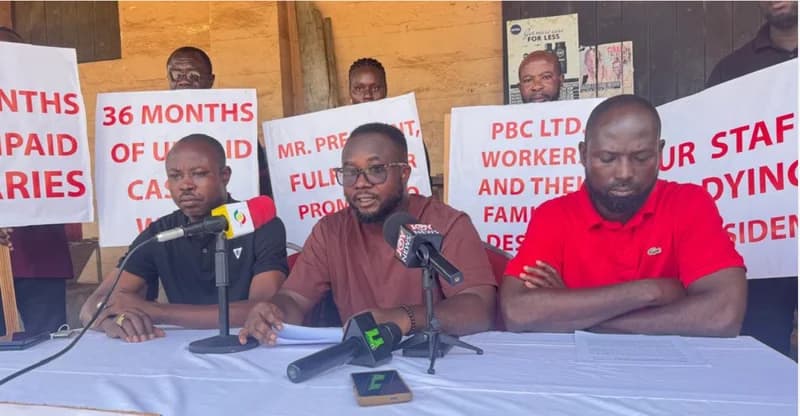
Simultaneously, the Mahama administration is facing mounting pressure from the labor sector, particularly from employees of PBC Limited. Workers at the leading cocoa purchasing company held a press conference in Kumasi to demand the payment of salaries that have been outstanding for 27 months, while casual workers have faced delays of up to 36 months. Osbert Baffoe Ansah, Chairman of the PBC Professional and Managerial Staff Union, called on President John Dramani Mahama and Finance Minister Dr. Cassiel Ato Forson to fulfill campaign promises to revitalize the distressed company and return the Buipe Shea Processing Factory to its control. This labor unrest coincides with a debate over a proposed new Labour Bill aimed at protecting gig economy and remote workers. Labour analyst Austin Gamey has expressed skepticism toward the bill, arguing that the government should focus on enforcing existing laws rather than introducing a new framework that could complicate industrial relations.
In the agricultural sector, the government is attempting to stabilize the economy through significant policy interventions in cocoa and grain markets. The Ghana Cocoa Board (COCOBOD) has announced it will maintain the producer price of cocoa at GH¢1,241.76 per 30kg load and GH¢2,587.00 per 64kg bag for the 2026 Light Crop Season to shield farmers from declining global prices. Furthering this agenda, President Mahama announced plans for a new Cocoa Bill that would guarantee farmers at least 70% of the world market price and mandate that 50% of Ghana’s cocoa be processed locally to create jobs. Additionally, the Ministry of Food and Agriculture has registered 45 Licensed Buying Companies with a GHS 300 million budget to procure grains directly from farmers, aiming to eliminate exploitative middlemen and manage food gluts in rice and maize.
These interconnected issues highlight a critical period for the Ghanaian government as it balances fiscal stability with social demands. While the opposition, led by figures like Oppong Nkrumah and Stephen Amoah, calls for deeper structural reforms and an enabling environment for the private sector, the administration is doubling down on legislative interventions and state-backed purchasing schemes. The success of these initiatives will likely depend on the government's ability to resolve the immediate liquidity crisis at PBC Limited and demonstrate tangible results from its youth employment frameworks. As the 2026 Light Crop Season begins on June 18, the focus remains on whether these policies can provide the economic relief promised to both rural farmers and the urban youth.
This story touches markets covered on Anansi Intelligence ↗.
Related topic
John Mahama: Latest News & Updates →More from politics
Continue exploring similar stories


