Ghana News AI
HomeBriefsAsk GhanaAnalysisTopicsAbout
•
•

Stay Informed

Get AI-curated news briefs from Ghana delivered to your inbox every morning. Free forever, no spam.

Explore

  • Home
  • Briefs
  • About

Features

  • Analysis
  • Cedi Rates
  • Dollar to Cedi
  • Ghana Gold Price

Topics

  • All Topics
  • Armed Forces Recruitment
  • Immigration Service Recruitment
  • Fire Service Recruitment
  • Prisons Service Recruitment
  • Customs Recruitment
  • WAEC Results & News
  • Ghana Education Service

Legal

  • Privacy Policy
  • Terms of Service
Ghana News AI© 2026 Ghana News AI. All rights reserved.
Made withfor Ghana
africa

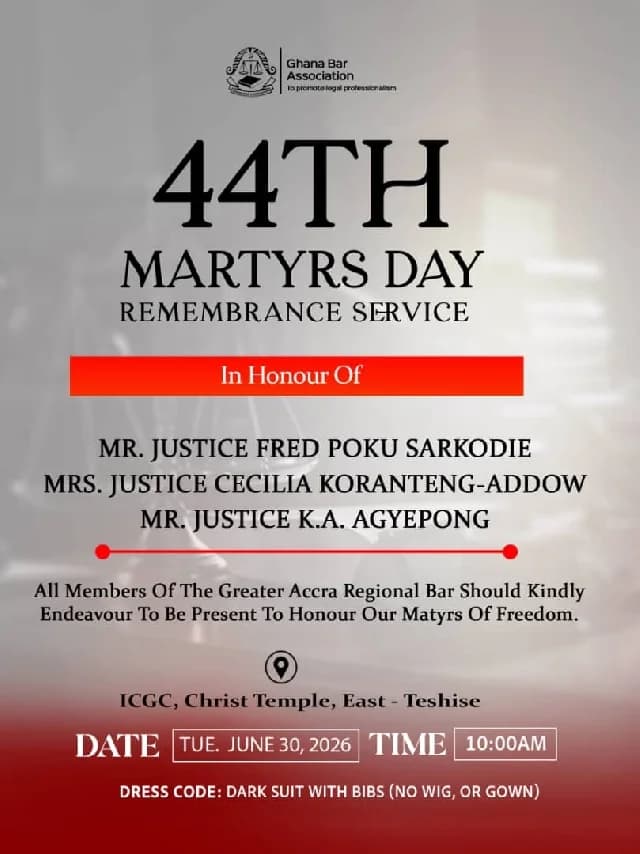
Ghana Bar Association to Commemorate 44th Martyrs Day in Honor of Slain High Court Judges

2 days ago•2 min read•1 source
Ghana Bar Association to Commemorate 44th Martyrs Day in Honor of Slain High Court Judges

The Ghana Bar Association (GBA) has announced the upcoming 44th Martyrs Day Remembrance Service, a solemn annual event dedicated to honoring the memory of three High Court judges who were tragically murdered decades ago. Scheduled for June 30, 2026, at 10:00 AM, the service will be hosted at the International Central Gospel Church (ICGC) in Teshie, Accra. This commemoration remains a cornerstone of the legal calendar in Ghana, serving as both a memorial and a platform for reaffirming the profession's commitment to the rule of law and the sanctity of the justice system. The event marks the anniversary of the harrowing events of June 30, 1982, during the administration of the Provisional National Defence Council (PNDC). On that night, Justice Kwadwo Adjei Agyepong, Justice Poku Sarkodie, and Justice Mrs. Cecilia Koranteng-Addow, along with Major Sam Acquah, a retired army officer, were abducted from their homes and brutally executed at the Bundase Military Range. The discovery of their charred remains days later sent shockwaves through the country and the international legal community, highlighting the extreme risks faced by those who stood for judicial integrity during periods of intense political instability. In preparation for the 2026 service, the GBA has issued specific directives to its members, including the request for attendees to wear dark suits as a sign of respect and mourning. To maintain the solemnity of the occasion without the formalities of the courtroom, the association has indicated that wigs and gowns are to be excluded from the required attire. The gathering at the ICGC is expected to draw a significant number of legal practitioners, members of the judiciary, and the general public, all joining together to pay their respects to those described as martyrs of the rule of law. Beyond the immediate act of remembrance, Martyrs Day serves as a vital reminder of the necessity of judicial independence in a democratic society. By revisiting this painful history every year, the GBA and the wider judiciary signal their resolve to ensure that such atrocities are never repeated. The service underscores the ongoing struggle to protect the sanctity of the courts and the safety of those who preside over them, reinforcing the idea that a truly free society depends on a judiciary that can operate without fear of retribution or violence.

Our Take

From the Team

Coming Soon

Our team will add key insights, trends, and actionable takeaways to help you stay informed faster.

This story touches markets covered on Anansi Intelligence ↗.

More from africa

Continue exploring similar stories

Ejura-Sekyeredumasi and Tano South Municipalities Lead Local Development with Social and Sanitation Initiatives
africa|2 days ago

Ejura-Sekyeredumasi and Tano South Municipalities Lead Local Development with Social and Sanitation Initiatives

Municipal Assemblies across Ghana are intensifying efforts to improve the livelihoods of vulnerable citizens and enhance environmental sanitation within their jurisdictions. In recent developments, the Ejura-Sekyeredumasi Municipal Assembly in the Ashanti Region and the Tano South Municipal Assembly in the Ahafo Region have rolled out significant interventions aimed at sustainable development. While Ejura-Sekyeredumasi has focused on empowering Persons with Disabilities (PWDs) through economic and educational support, Tano South is tackling waste management challenges by distributing critical infrastructure to local communities. The Ejura-Sekyeredumasi Municipal Assembly recently provided comprehensive assistance to 136 persons with disabilities, utilizing the District Assemblies Common Fund for the 2025 cycle. This initiative included the distribution of deep freezers, startup capital, and educational materials designed to foster long-term economic independence. Municipal Chief Executive (MCE) Rafiu Adam Seidu emphasized that these measures are specifically intended to reduce the reliance of PWDs on street begging by enabling them to establish sustainable small businesses. Despite broader financial constraints, the MCE noted that additional support from a local Member of Parliament helped bridge the funding gap, ensuring that beneficiaries received the tools necessary to enhance their livelihoods and support their families. In parallel with social welfare efforts, the Tano South Municipal Assembly is prioritizing public health through a strategic waste management initiative. MCE Emmanuel Kwame Frimpong recently handed over skip containers to assembly members to mitigate waste disposal issues exacerbated by the municipality's growing population. This distribution aligns with national sanitation commitments and represents a proactive approach to environmental health. MCE Frimpong announced plans to provide four new containers annually and called for a collective sense of responsibility among residents, urging them to maintain the equipment and use it effectively to improve community cleanliness. These municipal-led initiatives underscore the critical role of local government in driving grassroots development and social equity in Ghana. In Ejura-Sekyeredumasi, the assembly plans to conduct monitoring visits over the coming months to assess the impact of the tools and capital provided to beneficiaries. Meanwhile, the sanitation efforts in Tano South reflect a strategic response to urbanization and infrastructure needs. Together, these actions highlight a multifaceted approach to governance where social inclusion and environmental sustainability are pursued as core components of community progress.

Uganda's Military Forces Shutdown NTV Uganda and Spark TV Amid Growing Concerns Over Media Freedom
africa|2 days ago

Uganda's Military Forces Shutdown NTV Uganda and Spark TV Amid Growing Concerns Over Media Freedom

In a move that has sparked widespread international condemnation, the Ugandan military has forcibly shut down the operations of the country’s leading independent media outlets, including NTV Uganda and Spark TV. The military intervention, reportedly linked to orders from Army Chief Muhoozi Kainerugaba, saw security forces storming the premises of these media houses, effectively halting all broadcasting and editorial activities. This sudden escalation against the press has raised urgent concerns about the state of democratic discourse and the safety of journalists operating within the East African nation. The Federation of African Journalists (FAJ) has issued a stinging rebuke of the military’s actions, demanding the immediate reopening of the affected stations. Omar Faruk Osman, the President of FAJ, characterized the shutdown as a blatant manifestation of authoritarian rule, asserting that the use of military force to silence independent media is a direct assault on the fundamental rights of the Ugandan people. Various other media advocacy organizations have joined the call for restoration, noting that such pressures on independent journalism have become increasingly frequent, creating a climate of fear and self-censorship among the press corps. While General Muhoozi Kainerugaba has reportedly engaged in preliminary discussions regarding the potential reopening of the media houses, no official timeline or formal communication has been released to the public or the management of the affected stations. This lack of transparency has left the operations of NTV Uganda and Spark TV in a state of limbo, further straining the relationship between the state and the media. The international community continues to monitor the situation closely, as the outcome of this standoff is seen as a critical indicator of Uganda’s commitment to press freedom and the rule of law in the region.

Human Rights Watch Reports Grave Abuses Against Civilians by Malian Army and Islamic Militants
africa|2 days ago

Human Rights Watch Reports Grave Abuses Against Civilians by Malian Army and Islamic Militants

A recent report by Human Rights Watch has uncovered a disturbing escalation of grave abuses against civilians in Mali, committed by both the national armed forces and insurgent groups. The findings highlight a grim reality where non-combatants are increasingly caught in the crossfire of renewed fighting. According to the international watchdog, the violence has reached a critical point, with both the Malian army and Islamic militants, specifically the Al-Qaeda-linked Jama'at Nusrat al-Islam wal-Muslimin (JNIM), implicated in widespread human rights violations that continue to destabilize the Sahel region. The report provides harrowing details of operations led by the Malian armed forces that resulted in the deaths of at least 38 civilians. Most alarmingly, 23 of the victims were identified as children, underscoring the indiscriminate nature of the military's current strategy during its counter-insurgency operations. These incidents occurred amidst a broader backdrop of intensified military campaigns aimed at reclaiming territory from insurgent groups, yet the heavy toll on civilian life suggests a persistent failure to distinguish between combatants and innocent residents. The documentation of these killings points to a troubling culture of impunity within the security forces, which remains a primary concern for international human rights observers. Simultaneously, JNIM fighters have been accused of perpetrating severe atrocities as part of their campaign against the state. The report highlights a coordinated assault on the capital, Bamako, and its surrounding areas, marking a significant escalation in the militants' reach and their ability to strike major urban centers. These attacks are often characterized by indiscriminate violence intended to destabilize the central government and exert control over local populations. The interplay between state-led operations and militant retaliation has created a volatile environment where the safety of Malian citizens is frequently sacrificed for tactical military gains. The ongoing conflict has triggered a massive humanitarian crisis, forcing thousands of Malians to flee their homes and seek refuge in neighboring countries. Witnesses have described a landscape of fear, marked by accounts of extrajudicial killings and the constant threat of violence from all warring parties. Human Rights Watch emphasizes that the lack of accountability for these crimes continues to fuel a vicious cycle of violence. Without significant international pressure and domestic reform to ensure justice for victims, the humanitarian situation in Mali is expected to deteriorate further, leaving millions at risk in a region already plagued by chronic instability.

Switzerland Returns 18 Stolen Benin Bronzes to Nigeria as Global Repatriation Efforts Intensify
africa|2 days ago

Switzerland Returns 18 Stolen Benin Bronzes to Nigeria as Global Repatriation Efforts Intensify

Swiss authorities have officially returned 18 Benin Bronzes to Nigeria, marking a significant milestone in the ongoing international movement to repatriate cultural artifacts looted during the colonial era. The handover took place during a formal ceremony at the National Museum in Lagos, where Swiss officials transferred the items to Nigerian authorities. This restitution is part of a broader, accelerating trend across Europe and the West to return historical treasures that were seized from African nations under colonial rule, reflecting a growing global acknowledgment of the historical injustices surrounding these acquisitions.The collection returned by Switzerland includes a diverse range of artifacts, most notably a bronze bracelet and four Ikom monoliths. These items were originally part of the vast cultural wealth of the Kingdom of Benin, which was systematically looted by British forces during a punitive expedition in 1897. While the artifacts passed through various hands and eventually into Swiss collections, Swiss officials at the ceremony acknowledged the "painful history" associated with these pieces. Their return is seen as a step toward reconciliation and a recognition of Nigeria's rightful ownership of its cultural heritage.During the ceremony, Nigeria's Culture Minister, Hannatu Musa Musawa, emphasized the profound cultural and spiritual significance of the returned bronzes. She highlighted that these items are not merely artistic objects but essential fragments of Nigeria's national identity and history. The return of these specific items, particularly the Ikom monoliths, underscores the diversity of the artifacts being reclaimed and the commitment of the Nigerian government to secure the return of its heritage from various international jurisdictions.While the return of the bronzes is celebrated as a diplomatic and cultural victory, it also brings to the fore complex internal discussions within Nigeria regarding the final custody of the items. As more artifacts return from various countries, the Nigerian government faces ongoing challenges in determining the permanent placement and management of these treasures among national museums and traditional leadership institutions. Nevertheless, the Swiss restitution adds momentum to the continental push for the return of African heritage, setting a precedent for other nations to follow suit in addressing the legacy of colonial-era looting.

All
africa
business
education
entertainment
health
news
politics
sports
technology