••
Sir Sam Jonah Challenges New UCC Vice-Chancellor to Lead Artificial Intelligence Revolution and Curriculum Reform
•3 min read•10 sources
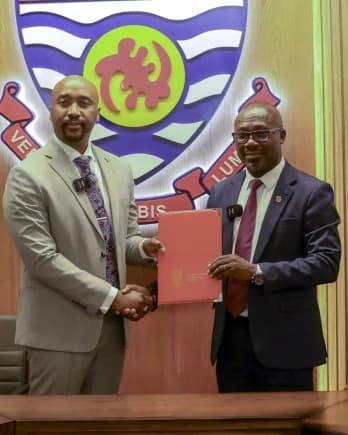
The University of Cape Coast (UCC) has formally inducted Professor Denis Worlanyo Aheto as its 12th Vice-Chancellor, marking a significant transition in the institution's leadership. During the investiture ceremony, Chancellor Sir Sam Jonah issued a powerful call for the university to radically overhaul its curriculum to meet the demands of a technology-driven world. Succeeding Professor Johnson Nyarko Boampong, Professor Aheto takes the helm at a time when traditional educational models are being challenged by the rapid advancement of Artificial Intelligence (AI), prompting a nationwide discussion on the future of higher education in Ghana.
Sir Sam Jonah emphasized that the traditional reliance on rote memorization and the transmission of theoretical knowledge has become obsolete in what he termed the "Age of Answers." He warned that universities risk irrelevance if they fail to shift toward skills-based learning and project-based assessments. Highlighting global trends, Jonah noted that institutions like MIT, Harvard, and Stanford are fundamentally redesigning their frameworks, and he urged UCC to follow suit by producing "bilingual" graduates—those proficient in their specific academic fields as well as AI. He further advocated for the establishment of AI innovation hubs and a vocational education faculty to nurture irreplaceable human traits such as ethical judgment, empathy, and complex problem-solving.
In his inaugural address, Professor Aheto committed to a transparent, results-oriented administration, pledging to integrate digital literacy and AI across all faculties. His four-year agenda includes the introduction of new academic programs in AI and Cybersecurity, the expansion of student facilities, and a strategic review of the university’s corporate plan. As part of this digital transformation, UCC has already launched the "UCC eCampus," an online platform designed to provide flexible postgraduate education for working professionals across Africa and beyond. Aheto, a distinguished academic with a background in coastal ecology and marine conservation, aims to ensure that UCC maintains its reputation for excellence while becoming more accessible to a global audience.
Beyond digital innovation, the leadership transition signals a broader push toward practical competence and vocational training. Sir Sam Jonah encouraged the university to lead a shift in priorities from traditional academic approaches to practical application, proposing new programs such as a Bachelor of Applied Skills in Renewable Energy Systems. By fostering partnerships with industry and enhancing mentorship programs, UCC seeks to equip graduates with the hands-on skills necessary to drive national development. This new direction aims to protect the standards of Ghana’s tertiary education while ensuring that future graduates are not just degree holders, but innovative problem-solvers ready to compete in the global digital landscape.
This story touches markets covered on Anansi Intelligence ↗.
More from education
Continue exploring similar stories


