••
Vice-President Opoku-Agyemang and Industry Leaders Call for Educational Reform to Drive National Development
•2 min read•6 sources
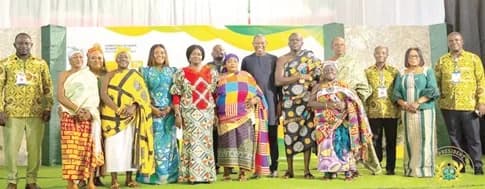
Vice-President Professor Naana Jane Opoku-Agyemang has called for a renewed focus on effective leadership and tangible learning outcomes within Ghana’s basic education sector. Speaking at the 5th Quadrennial National Conference of the Conference of Heads of Basic Schools (COHBS) in Koforidua, the Vice-President emphasized that educational interventions must translate into quality education for every child. This call for systemic improvement comes as Ghana celebrates a significant boost to its human capital, following the return of 118 scholars from Russia. These postgraduates, sponsored by the Jospong Group and the African Agribusiness Consortium (AAC), completed two years of intensive training in agriculture, environmental sciences, and waste management at RUDN University, specifically to support Ghana’s food security and sustainability goals.
The push for academic relevance is also being felt at the tertiary level, where the Christian Service University (CSU) has launched a new Doctor of Ministry in Christian Leadership and Management. Acting Vice-Chancellor Dr. Stephen Banahene noted that the program aims to bridge the gap between academic scholarship and practical ministry, equipping leaders to better address complex societal and governance challenges. This move toward specialized, high-level training reflects a broader national shift toward education that serves specific developmental and ethical needs in both African and global contexts.
Technological advancement remains a cornerstone of this educational evolution, highlighted by the inauguration of a new Information and Communication Technology (ICT) Centre at Wesley Girls’ Basic School in Cape Coast. Funded by the Korea International Cooperation Agency (KOICA) and the Korean University Council for Social Service (KUCSS), the facility provides essential hardware and cultural exchange opportunities. While such donations are vital, industry experts like Derrick Abaitey, founder of Konnected Minds, argue that infrastructure must be matched by a curriculum shift. Abaitey warned that Ghana continues to focus too heavily on theory, advocating for structured pathways that integrate vocational and hands-on skills to prepare graduates for the evolving job market.
Ultimately, leaders view these educational investments as essential for national security and democratic stability. Dr. Mohamed Ibn Chambas, the African Union’s High Representative for Silencing the Guns, recently emphasized that a nation’s true wealth is found in its education rather than its military or natural resources. As the government, through the Ministry of Education, pledges to tackle challenges such as teacher posting disparities and the timely provision of supplies, the collective focus remains on transforming the classroom into a foundation for peace, prosperity, and responsible citizenship.
This story touches markets covered on Anansi Intelligence ↗.
More from education
Continue exploring similar stories


