Ghana News AI
HomeBriefsAsk GhanaAnalysisTopicsAbout
•
•

Stay Informed

Get AI-curated news briefs from Ghana delivered to your inbox every morning. Free forever, no spam.

Explore

  • Home
  • Briefs
  • About

Categories

  • Politics
  • Business
  • Sports
  • Entertainment
  • Africa

Features

  • Analysis
  • Cedi Rates
  • Dollar to Cedi
  • Ghana Gold Price

Topics

  • All Topics
  • Armed Forces Recruitment
  • Immigration Service Recruitment
  • Fire Service Recruitment
  • Prisons Service Recruitment
  • Customs Recruitment
  • WAEC Results & News
  • Ghana Education Service

Legal

  • Privacy Policy
  • Terms of Service
Ghana News AI© 2026 Ghana News AI. All rights reserved.
Made withfor Ghana
politics

Internal Tensions Rise in NPP and NDC Over Election Guidelines and Premature Campaigning

31st May•3 min read•12 sources
Internal Tensions Rise in NPP and NDC Over Election Guidelines and Premature Campaigning
  1. Home
  2. /Politics
  3. /Internal Tensions Rise in NPP and NDC Over Election Guidelines and Premature Campaigning

As Ghana’s major political parties prepare for future electoral cycles, both the New Patriotic Party (NPP) and the National Democratic Congress (NDC) are grappling with internal friction regarding election protocols and candidate discipline. In late May 2026, the NPP faced simultaneous challenges from its Asante Mampong constituency and its USA branch over electoral guidelines, while the NDC Council of Elders issued a stern cease-and-desist order to members engaging in premature presidential campaigning. These developments highlight a growing emphasis on party discipline and the integrity of internal democratic processes as leadership seeks to maintain cohesion ahead of upcoming national transitions.

In the Asante Mampong constituency, a faction led by spokesperson Isaac Owusu Acheampong has voiced strong opposition to the resumption of polling station executive elections scheduled for May 31, 2026. The group cites unresolved issues from a previous suspension on May 14, including the use of unapproved voter registers and a perceived lack of transparency. According to the faction, only two out of 145 polling stations had completed their processes before the initial halt, raising concerns about the legitimacy of the upcoming vote. Parallel to these local concerns, the NPP-USA branch held an emergency virtual meeting where members voted 20 to 9 to retain their existing 2021 bylaws for the 2026 internal elections. This decision defers new national guidelines proposed by General Secretary Justin Kodua Frimpong, citing conflicts regarding candidate eligibility and voting methods that the branch intends to address at its July conference in Massachusetts.

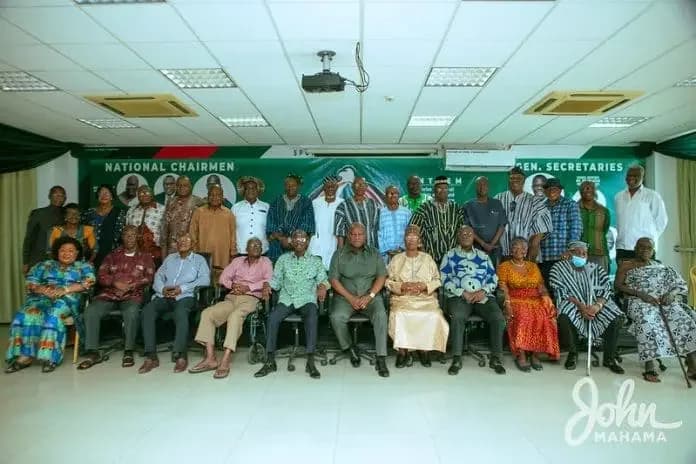
Simultaneously, the NDC is focused on curbing internal factionalism and "jostling" for the 2028 presidential ticket. Following an emergency meeting with President John Dramani Mahama on May 29, 2026, the party’s Council of Elders warned aspirants to halt all unauthorized campaign activities immediately. The Council expressed concern that early campaigning undermines the government's "Resetting Agenda" and distracts from national governance priorities. Referencing Article 42 of the NDC Constitution, the elders reminded members that the National Executive Committee (NEC) has not yet set a formal timeline for presidential primaries, making any current campaigning a breach of party discipline.

These internal disputes across both ends of the political spectrum underscore the delicate balance between local or branch autonomy and national party authority. Whether it is the demand for verified voter registers in Asante Mampong or the NDC's call for unity behind the current administration's developmental goals, the actions taken by party leadership in the coming months will be critical. As both the NPP and NDC move toward their respective national conferences and primary seasons, the resolution of these procedural and disciplinary conflicts will likely determine the stability of their platforms heading into the next general election cycle.

Our Take

From the Team

Coming Soon

Our team will add key insights, trends, and actionable takeaways to help you stay informed faster.

This story touches markets covered on Anansi Intelligence ↗.

More from politics

Continue exploring similar stories

Global Governance in Flux: From Military Accountability to Groundbreaking Shifts in Political Representation
politics|Yesterday

Global Governance in Flux: From Military Accountability to Groundbreaking Shifts in Political Representation

The landscape of global politics is currently defined by a sharp tension between traditional institutional discipline and the push for modern societal reforms. In the United States, the Air Force has launched a formal investigation into Major Jason Watson, an active-duty officer who publicly called for the impeachment of President Donald Trump and Vice President JD Vance during a protest at the Capitol. Watson, who was detained by Capitol Police while holding a sign advocating for impeachment, cited military engagements without congressional approval as his primary grievance. The Air Force emphasized its commitment to a nonpartisan military, noting that Watson's actions potentially violate Article 88 of the Uniform Code of Military Justice, which prohibits contemptuous speech against government officials. Watson has acknowledged the potential career-ending consequences of his dissent, prioritizing his personal message over professional risk. Simultaneously, Japan is grappling with a landmark shift in political norms as Shoko Kawata, the 35-year-old mayor of Yawata, became the first mayor in the country’s history to take maternity leave. Scheduled for four months, Kawata's decision has ignited a fierce national debate regarding the balance between public duty and family life in a country that ranks poorly on the gender gap index. While colleagues and supporters hail the move as a vital step for women in politics, critics have labeled it irresponsible, highlighting the lack of a legal framework for elected officials on leave. This struggle for modernization is mirrored in Indonesia’s Aceh province, where Sharia law remains strictly enforced; recently, a young couple received 21 lashes each for the simple act of kissing during a TikTok livestream, drawing condemnation from international human rights groups like Amnesty International. Accountability and historical identity also remain at the forefront of regional politics. In South Africa, the government has sternly criticized former President Jacob Zuma for meeting with Ajay Gupta in India, calling the visit a "parallel foreign policy" that undermines ongoing corruption investigations. This occurs amid rising anti-migrant sentiments in South Africa, which have drawn sharp rebukes from Ghanaian figures like broadcaster Nana Aba Anamoah, who criticized activist Jacinta Ngobese-Zuma for promoting hatred. Meanwhile, in Ghana, the intersection of traditional and modern governance was celebrated as the Yagbonwura joined the Asantehene for the Awukudae festival, and US Lawmaker Carol Ammons was enskinned as a Queen Mother in Paga after tracing her ancestry to the region, pledging to use her office to advocate for reparative justice for the African diaspora. Closer to home, Ghanaian leaders are emphasizing the inescapability of political engagement for national development. Former Ambassador Boniface Gambila recently argued at the Upper East Regional Development Strategic Forum that complete political neutrality is a misconception, as politics governs every facet of life. This sentiment was echoed by Vice President Jane Naana Opoku-Agyemang during the 66th Republic Day cadet parade, where she urged the youth to embrace discipline and integrity as the bedrock of democracy. As Algeria faces record-low voter turnout in its parliamentary elections and Germany debates the economic impact of new sick-leave policies, these diverse events underscore a global period of political realignment where the roles of citizens, soldiers, and leaders are being fundamentally redefined.

Keta MP Demands Urgent Flood Relief While National Leaders Drive Infrastructure, Agricultural, and Social Reforms
politics|Yesterday

Keta MP Demands Urgent Flood Relief While National Leaders Drive Infrastructure, Agricultural, and Social Reforms

Ghanaian lawmakers and government officials are intensifying efforts to address regional crises and infrastructure deficits across the country. In the Keta constituency, Member of Parliament Dzudzorli Kwame Gakpey has issued an urgent call for intervention as severe flooding—described as some of the worst in recent history—submerges homes and devastates farmlands in communities like Klovi, Anloga, and Afiadenyigba. The MP attributed the crisis to human activities, including salt mining and improper waste disposal, which have obstructed natural drainage systems. In response, emergency measures are being coordinated with local authorities to cut a sandbar at Kedzi to facilitate water flow into the sea, while long-term solutions such as dredging the lagoon remain a priority. Parallel to these emergency efforts, significant investments in local infrastructure are being unveiled. In the Ellembelle District, DCE Joseph Armah Agyekum announced that 20% of the District Assemblies Common Fund (DACF) has been allocated to complete projects, including a GH800,000 District Assembly Office Complex and a GH9 million market complex in Esiama. Similarly, in Agona East, MP Queenstar Maame Pokuah Sawyer commissioned a new AstroTurf at Agona Nantifa to promote youth development. This push for modernization is supported by the Ministry of Energy and Green Transition, which recently donated 100 streetlights and cash to 16 MMDCEs in the Central Region to enhance public safety and visibility under the government's 'Big Push' agenda. On the national policy front, Vice President Professor Jane Naana Opoku-Agyemang has committed the government to integrating agroecological and nature-based farming into the 'Feed Ghana Programme.' This initiative, highlighted at the CIRAWA International Conference, aims to bolster food security through sustainable practices. Meanwhile, in Parliament, Salaga South MP Hajia Zuwera Mohammed Ibrahimah is championing social reform by urging a closure of regulatory gaps that foster child abuse. Citing statistics that 22% of children aged 1-14 face violent discipline, Ibrahimah called for transformative policies and stricter accountability to protect Ghana’s youth from egregious abuse in schools. These combined actions reflect a broader governance strategy focused on balancing immediate disaster response with long-term economic and social development. As Ellembelle prepares for elevation to municipal status and MMDCEs push for the expansion of electricity infrastructure in underserved areas, the emphasis remains on sustainable growth and community resilience. The success of these initiatives will depend on the continued collaboration between local authorities, the legislature, and the executive branch to ensure that development projects are maintained and that regulatory reforms are effectively enforced across the nation.

President Mahama Champions National Resilience and Welfare Reforms for Senior Citizens
politics|Yesterday

President Mahama Champions National Resilience and Welfare Reforms for Senior Citizens

President John Dramani Mahama has reaffirmed his administration's commitment to national unity and social welfare, leading the country through a period of spiritual reflection while pledging transformative reforms for retirees. Speaking across two major events—the National Day of Prayer and Thanksgiving and the Republic Day Senior Citizens’ Luncheon—the President emphasized that Ghana's progress depends on both moral integrity and a robust support system for those who have served the nation. He underscored the importance of resilience, noting that national recovery hinges on individual choices and collective dedication to the state. During the National Day of Prayer and Thanksgiving, President Mahama joined religious leaders at the National Mosque to seek divine guidance following recent devastating floods. Addressing public concerns about the event's timing, Elvis Afriyie-Ankrah, the Presidential Envoy for Interfaith and Ecumenical Relations, clarified that the observance was a pre-planned annual event and not a reactive measure to the disaster. While the mood was somber, the President used the platform to urge Ghanaians to reject corruption in favor of integrity. He emphasized that the government remains committed to providing financial aid and relief to flood victims, stressing that spiritual gratitude and practical humanitarian responses are equally vital to national healing. Shifting focus to social protection, President Mahama expressed a profound "unrepayable debt" to Ghana’s senior citizens during a celebratory luncheon in Accra. He advocated for a society where the elderly live with dignity, security, and accessible healthcare, acknowledging the contributions of retired teachers, healthcare professionals, and farmers. To support this vision, he introduced the "Mahama Cares" Medical Trust Fund, designed to provide assistance to seniors battling chronic illnesses. He also called on younger generations to preserve the extended family system to prevent the isolation of the elderly, ensuring that the wisdom of the older generation continues to guide the nation’s moral values. Central to this vision for senior welfare are proposed economic and pension reforms linked to the country's recovery. President Mahama pledged to enhance pension benefits as the economy stabilizes, highlighting initiatives such as the "24-hour Economy" and the "Accelerated Export Development Programme" as drivers of the growth needed to fund these improvements. By aligning economic recovery with social justice, the President aims to ensure that retired workers who contributed to Ghana’s development can lead dignified lives. These measures reflect a broader strategy to foster a prosperous nation that honors its past while securing a stable future for all citizens.

Ghanaian Leaders and Legal Experts Propose Sweeping Institutional Reforms to Strengthen Democracy and Public Accountability
politics|Yesterday

Ghanaian Leaders and Legal Experts Propose Sweeping Institutional Reforms to Strengthen Democracy and Public Accountability

In a series of significant developments aimed at fortifying Ghana's democratic foundations, prominent leaders and legal experts are calling for systemic reforms to ensure transparency and institutional integrity. Highlighting this shift, President John Dramani Mahama has appointed Dr. Pamela Graham as Ghana's first female Auditor-General. During her swearing-in ceremony at the Presidency, President Mahama underscored the critical role the Auditor-General plays in public financial management and accountability. Dr. Graham, who brings 25 years of private sector experience to the role, pledged to uphold the highest standards of performance and integrity in her new constitutional duty, marking a milestone for gender representation in the nation's high-level governance. Complementing these executive actions, legal scholar Professor Stephen Kwaku Asare, also known as Kwaku Azar, has proposed five essential reforms to revitalize Ghana's democracy. Speaking at a forum organized by Solidaire Ghana, Prof. Asare advocated for the establishment of an independent Commissioner for Political Parties to regulate the activities of major groups like the NPP and NDC. His proposals include shifting the focus of political leadership from financial strength to grassroots participation, implementing strict campaign expenditure limits, and ensuring a clear separation between political parties and the state. These reforms aim to recover the autonomy of state institutions, particularly Parliament, and foster a political culture driven by ideas rather than personalities. Professionalism within the public and security sectors has also emerged as a priority for national progress. Professor Michael Kpessa-Whyte, speaking at the 7th Cohort Inauguration of Emerging Public Leaders of Ghana (EPL Ghana), urged new public officers to view their careers as legacies of service rather than mere jobs. He emphasized that the character of individual officers—defined by stewardship and responsiveness—will ultimately shape the strength of Ghana's institutions. Similarly, former Chief of Naval Staff Issah Yakubu has called for the expansion and professionalization of the Ghana Maritime Police Unit. Yakubu recommended that the unit be empowered to manage law enforcement within the first 12 nautical miles of Ghana's waters, allowing the Navy to focus on more complex national security threats. At the grassroots level, the push for accountability is being mirrored by civil society initiatives. The Ghana Anti-Corruption Coalition (GACC) recently concluded a training program in the Kumbungu District of the Northern Region, empowering citizens to demand transparency in local governance. The initiative has already seen tangible results, such as the inclusion of persons with disabilities in management committees and improved oversight of public contracts. Together, these top-down institutional reforms and bottom-up civic engagements represent a multi-faceted approach to building a more resilient and transparent Ghanaian state, where both officials and citizens are held to the highest standards of integrity.

All
africa
business
education
entertainment
health
news
politics
sports
technology