••
Ministry of Education Clarifies Basic School Language Policy; Foreign Languages Remain Optional
•2 min read•4 sources
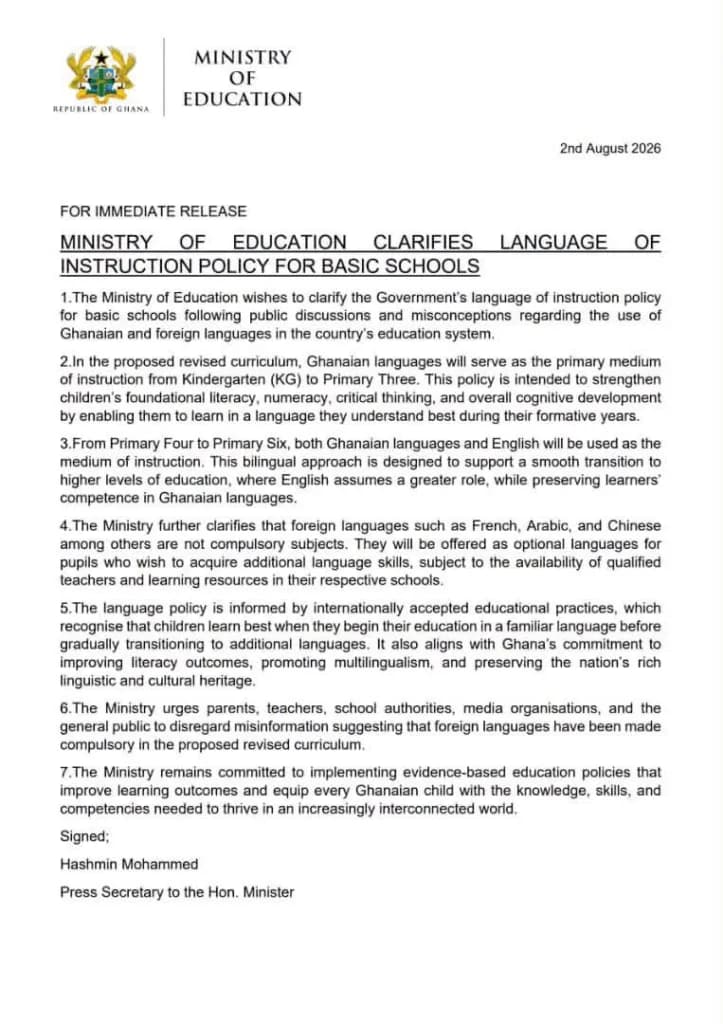
The Ministry of Education has issued a comprehensive clarification regarding the language of instruction policy within Ghana's revised basic school curriculum. The statement aims to dispel widespread misconceptions and public debate concerning the role of foreign languages in the classroom. According to the Ministry, the core of the policy prioritizes Ghanaian languages as the primary medium of instruction from Kindergarten through Primary Three. This approach ensures that young learners build a strong foundation in a language they already understand, which is essential for early literacy and cognitive development.
Under the revised framework, the instructional model follows a clear developmental trajectory. While the initial years (KG to P3) focus on indigenous languages as the primary medium, a gradual transition to a bilingual model begins in Primary Four. From this stage through Primary Six, both Ghanaian languages and English will be utilized as mediums of instruction. This staggered approach is designed to facilitate a smoother transition to higher educational levels where English becomes more dominant, while still preserving proficiency in indigenous languages and ensuring students do not struggle with conceptual learning due to language barriers.
Crucially, the Ministry emphasized that foreign languages, specifically French, Arabic, and Chinese, are not compulsory subjects under the new curriculum. These languages will be offered strictly as optional electives, and their inclusion in school schedules will be subject to the availability of specific teaching resources and qualified personnel. The Ministry urged parents, educators, and the general public to disregard misinformation suggesting that these foreign languages are mandatory additions to the basic school load, reiterating that the primary focus remains on strengthening foundational literacy.
By centering the early years of education on mother-tongue instruction, the government aligns its strategy with global pedagogical standards that highlight the benefits of learning in a child's first language. This policy not only supports academic success but also fosters a stronger sense of cultural identity among students. The Ministry of Education has called on all stakeholders to rely on official communications for updates on the curriculum, ensuring that the implementation of these educational reforms remains transparent and focused on improving long-term learning outcomes for all Ghanaian children.
This story touches markets covered on Anansi Intelligence ↗.
More from education
Continue exploring similar stories


