••
Microsoft Advances Quantum Computing with Majorana 2 Chip, Aiming for Commercial Viability by 2029
•2 min read•2 sources
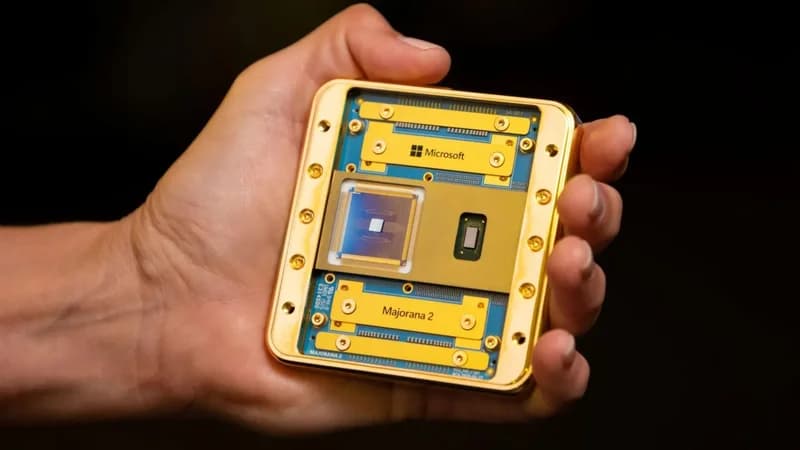
Microsoft has unveiled its latest quantum computing breakthrough, the Majorana 2 chip, which represents a massive leap in hardware stability. This new chip is reportedly 1,000 times more reliable than its predecessor, with its qubits maintaining coherence for an average of 20 seconds compared to the mere milliseconds achieved by the Majorana 1. This advancement is a critical step in Microsoft’s ambitious roadmap to develop a quantum computer capable of solving commercially viable problems by the year 2029.
The Majorana 2 chip utilizes unique "topological qubits," a specialized approach based on a quasiparticle theory dating back to the 1930s. While Microsoft’s path has faced scrutiny in the past—including a previously retracted research paper—the company remains steadfast in its methodology. To ensure the integrity of its findings, Microsoft is collaborating with the U.S. Defense Advanced Research Projects Agency (DARPA) to validate its concepts. Zulfi Alam, a Corporate Vice President at Microsoft, noted that while the current progress is significant, the transition from the current 12-qubit system to the millions of qubits required for a full-scale quantum machine remains a monumental engineering challenge.
Beyond theoretical physics, Microsoft’s quantum team is focusing on the practical implications of this technology for global sustainability and industry. Potential applications for the hardware include breakthroughs in environmental science, such as the elimination of microplastics, and advancements in agriculture through the development of more efficient fertilizers. The company emphasizes that its quantum ambitions are centered on empowering human problem-solving rather than simply replacing existing computational methods.
As the industry watches closely, the 2029 target serves as a bold marker for the future of high-performance computing. While experts maintain a level of cautious optimism due to the inherent fragility of quantum states, the 20-second reliability threshold of the Majorana 2 suggests that the era of practical quantum applications may be closer than previously anticipated. The successful scaling of this technology could eventually redefine how humanity tackles complex scientific and environmental crises on a global scale.
This story touches markets covered on Anansi Intelligence ↗.
More from technology
Continue exploring similar stories


