••
Microsoft Unveils Majorana 2 Quantum Chip, Claiming 1,000-Fold Increase in Reliability
•3 min read•1 source
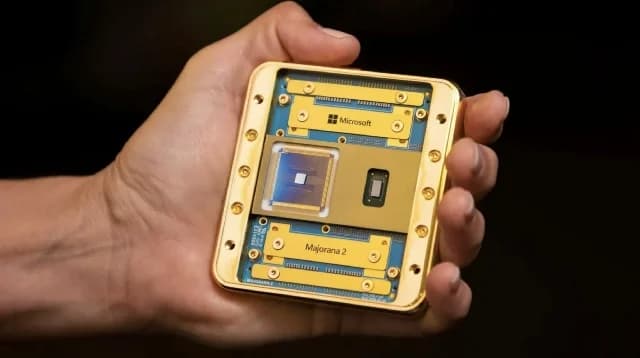
Microsoft has reached a significant milestone in the global race for quantum supremacy with the announcement of its new quantum chip, Majorana 2. The tech giant reports that this latest iteration is 1,000 times more reliable than its predecessor, Majorana 1, marking a substantial leap forward in the quest to build a functional quantum computer. This development is part of Microsoft’s ambitious roadmap to deliver a quantum machine capable of solving complex, commercially viable problems by 2029. By significantly extending the stability of qubits, Microsoft aims to overcome one of the most persistent hurdles in the field: the extreme fragility of quantum information.
The Majorana 2 chip currently features 12 qubits that can maintain their quantum state for an average of 20 seconds. While 12 qubits is far from the thousands required for universal quantum computing, the "topological" approach Microsoft employs is designed to inherently protect qubits from environmental noise. This stability is a critical metric, as traditional qubits often decohere in fractions of a second. To validate these performance claims, Microsoft is collaborating with the U.S. Defense Advanced Research Projects Agency (DARPA). The company believes that its unique architecture will eventually allow for the scaling necessary to tackle massive computations that remain beyond the reach of even the world’s most powerful classical supercomputers.
Despite the optimistic announcement, the scientific community remains cautious. Microsoft’s path has not been without controversy; the company previously faced setbacks, including the retraction of a high-profile paper regarding its quantum research. Furthermore, the claims surrounding the Majorana 2 have yet to be accompanied by a peer-reviewed publication, a standard requirement for scientific verification. Skeptics point out that while a 20-second lifespan is impressive, the transition from a dozen stable qubits to a fault-tolerant system capable of real-world application involves immense engineering challenges that are still being mapped out.
Looking ahead, Microsoft envisions a future where quantum computing and artificial intelligence work in tandem to solve some of the world's most pressing issues. The company highlighted potential applications in materials science, specifically using AI-enhanced quantum processes to address environmental crises such as microplastic pollution. As the tech sector's competitive race intensifies, Microsoft's 2029 target sets a clear deadline for the industry. While the inherent fragility of qubits continues to be a major obstacle, the advancements seen in the Majorana 2 chip represent a pivotal step toward a new era of computational power that could redefine science and industry.
This story touches markets covered on Anansi Intelligence ↗.
More from technology
Continue exploring similar stories


