••
Mahama Outlines Vision for 'National Reset' in London, Vows Stricter Accountability and Constitutional Reforms
•3 min read•66 sources
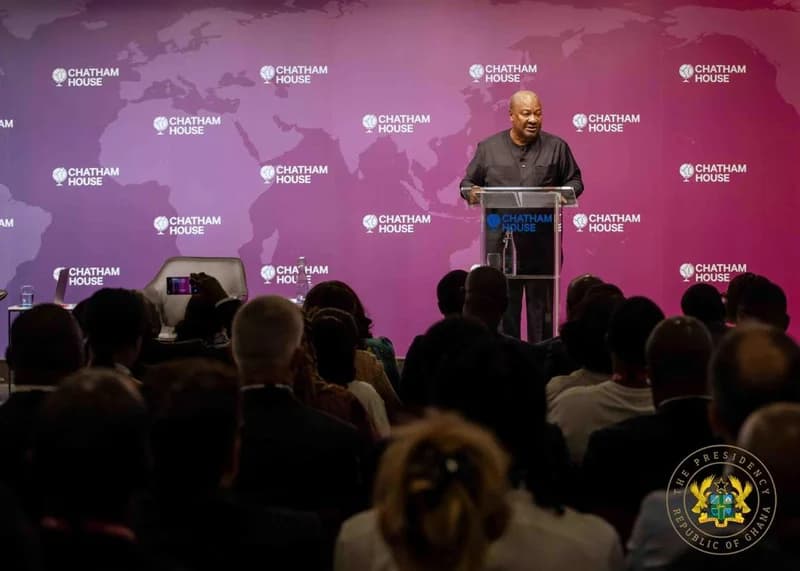
President John Dramani Mahama has concluded a high-profile diplomatic and community engagement tour in London, delivering a series of addresses at Chatham House and a Diaspora Town Hall meeting that outlined a comprehensive 'national reset' agenda for Ghana. Central to his message was a stern commitment to public accountability and the eradication of financial misappropriation, which he estimated costs the nation 12 billion cedis annually. Mahama announced the establishment of specialized audit courts to prosecute individuals implicated in Auditor-General reports, warning that public officials and heads of State-Owned Enterprises (SOEs) must either refund stolen funds or face imprisonment. This drive for transparency extends to local governance, where he vowed to dismiss officials who authorized illegal building permits in waterways and the Weija Dam spillway, citing these lapses as the primary cause of Accra’s perennial flooding.
Addressing economic transformation, the President detailed a bold value-addition strategy aimed at shifting Ghana from a raw material exporter to an industrial hub. A cornerstone of this plan is the revival of the Tema Oil Refinery (TOR), which is slated to begin processing Ghanaian crude oil locally by June 2026 to reduce dependency on imported fuel. Mahama also announced a proposed Local Content Bill and a sliding-scale royalty system for the mining sector, designed to increase state revenue to as much as 12% when global commodity prices rise. He emphasized that these reforms are necessary to ensure that natural resource wealth translates into domestic development and job creation, rather than benefiting only foreign conglomerates.
Recognizing the Ghanaian diaspora as the nation’s '17th region,' Mahama championed constitutional reforms to deepen their involvement in national governance. He endorsed the 'Constitution (Amendment) Bill, 2025'—which he termed the 'Gyakye Quayson Law'—to allow dual citizens to hold parliamentary and ministerial positions. With diaspora remittances exceeding $7.8 billion annually, Mahama argued that legal barriers to their political participation are outdated and counterproductive to national growth. However, the President also signaled a new era of fiscal pragmatism, notably ruling out government funding for large-scale fan travel to the 2026 FIFA World Cup, citing an estimated cost of $11,000 per person as an unjustifiable use of public resources.
On the global stage, Mahama used his platform at Chatham House to call for a fundamental restructuring of multilateralism, describing Africa’s lack of permanent representation on the UN Security Council as a 'historical injustice.' He provided a nuanced analysis of regional security, attributing the rise of terrorism in the Sahel to the collapse of Libya and calling for a collaborative security architecture that includes the UK, US, and France alongside regional neighbors like Algeria. He also reaffirmed Ghana’s commitment to Pan-Africanism, announcing the abolition of visa fees for African passport holders and a renewed push for reparatory justice for the transatlantic slave trade.
While the visit focused on a vision for progress, it was met with some domestic friction as a group of Ghanaian nationals protested outside the London venue, citing concerns over the cost of living and unpaid allowances for teachers and nurses. Despite these challenges, Mahama maintained that Ghana’s democratic tradition remains its 'strategic asset' in a fragmented global order. He concluded by emphasizing that his administration’s foreign policy would remain pragmatic and interest-driven, focusing on building domestic resilience and strong institutions to navigate the geopolitical and economic complexities of the 21st century.
This story touches markets covered on Anansi Intelligence ↗.
More from politics
Continue exploring similar stories


