••
President Mahama Mandates Massive Anti-Flood Operations in Accra as Experts Call for Official Accountability
•3 min read•8 sources
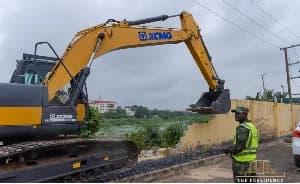
The National Flood Mitigation Task Force has launched a comprehensive operation across the Greater Accra Region to combat recurring flooding through a phased program of dredging, desilting, and the demolition of illegal structures. Mandated by President John Dramani Mahama, the initiative is being spearheaded by Deputy Chief of Staff Stan Xoese Dogbe and the Minister for Works, Housing, and Water Resources, Kenneth Adjei. The first phase of the operation has already targeted high-risk areas including East Legon, New England, Oyarifa, and the Tesa Dam, where unauthorized constructions obstructing natural waterways are being removed to restore proper drainage flow. Subsequent phases are expected to expand into Weija, Mallam, and Laboma to further secure the capital's infrastructure against heavy seasonal rains.
Supporting these enforcement efforts, the CEO of the Eco Impact Network, Mrs. Gifty Ofori-Yeboah, has issued a stern call for accountability within the public sector. She argues that the persistence of urban flooding in Ghana is not merely a consequence of heavy rainfall but is significantly exacerbated by the negligence of public officials who approve illegal developments in flood-prone zones. Mrs. Ofori-Yeboah is advocating for strict penalties, including suspension and prosecution, for officials whose approvals lead to community disasters. She emphasized that restoring public trust requires a dual approach: penalizing regulatory violations while simultaneously rewarding exemplary environmental stewardship and responsible waste disposal practices among citizens.
In tandem with these enforcement actions, eight Metropolitan, Municipal, and District Assemblies (MMDAs) have formally committed to implementing new climate adaptation plans. This pledge was made during the Urban Adaptation Implementation Accelerator Exchange in Tema, an initiative organized by the Covenant of Mayors in Sub-Saharan Africa. The MMDCEs involved are focusing on mobilizing climate finance and improving local governance to address coastal erosion and flood risks effectively. By learning from shared regional experiences and adopting infrastructure designs based on rigorous scientific assessments, these local authorities aim to move beyond reactive measures toward long-term urban resilience.
These combined efforts represent a multi-pronged strategy to address Ghana's environmental challenges by linking immediate physical intervention with policy reform and official accountability. As the Flood Mitigation Task Force continues its work, the focus remains on ensuring that drainage systems are permanently cleared of encroachments. Moving forward, the success of these initiatives will depend on the consistent enforcement of environmental laws and the ability of MMDAs to translate their climate adaptation pledges into tangible infrastructure projects that protect both lives and property from the impacts of climate change.
This story touches markets covered on Anansi Intelligence ↗.
Related topic
John Mahama: Latest News & Updates →More from politics
Continue exploring similar stories


