••
Multiple Fire Outbreaks Strike Koforidua and Amasaman as AMA Intensifies Safety Enforcement
•3 min read•7 sources
A series of significant fire outbreaks across Ghana’s Eastern and Greater Accra regions has resulted in millions of cedis in property damage and prompted aggressive enforcement of safety regulations by local authorities. In Koforidua, a devastating blaze late Saturday night destroyed several prominent businesses and residential apartments near the Central Police Station. Simultaneously, in Accra, emergency teams from four separate fire stations were forced to battle a large inferno behind the China Mall in Amasaman, highlighting a growing concern over fire safety in commercial zones.
The Koforidua incident began around 10:00 p.m. on October 3, 2026, reportedly starting from a top-floor residential room of a one-storey building near the Jackson Park traffic light. The fire quickly spread through the structure, gutting several businesses, including Mama Pee Collections and Kwaku Showboy Boutique. While the Ghana National Fire Service (GNFS) was eventually able to contain the blaze, the destruction was extensive. One firefighter sustained injuries during the operation and is currently receiving medical treatment. Both the GNFS and the police have launched investigations to determine the exact cause of the outbreak.
In the Greater Accra Region, the fire behind the Amasaman China Mall required a massive response, with firefighters deployed from Amasaman, Madina, Abelemkpe, and the GNFS Headquarters. This incident follows closely on the heels of a recent catastrophic fire at the Duraplast factory, which led to significant job losses and property damage. While no casualties were immediately reported in the Amasaman blaze, the proximity to major commercial hubs has heightened fears regarding industrial safety and the speed of emergency responses in densely populated areas.
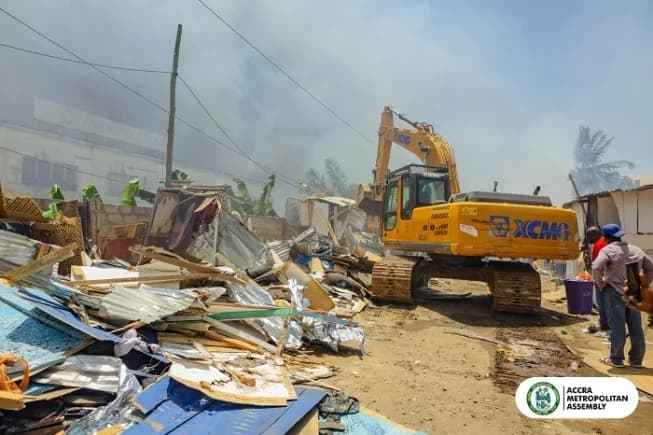
Reacting to the recurring issue of obstructed emergency access, the Accra Metropolitan Assembly (AMA), supported by the 48 Engineer Regiment of the Ghana Armed Forces, has begun the forceful removal of unauthorized structures in the Kofikrom area of the North Industrial Area. Municipal Chief Executive Michael Kpakpo Allotey stated that the operation was necessary because illegal settlements had previously hindered fire engines from reaching emergency sites. Despite a May 29, 2026, deadline to vacate, many occupants had remained, prompting the military-assisted clearance. Lt. Col. Frank Osei Amponsah emphasized that the military would continue to support efforts to ensure that access roads remain open for disaster response.
These combined events underscore a critical period for Ghana’s emergency services and urban planners. As investigators work to identify the triggers for the Koforidua and Amasaman fires, the AMA has vowed to maintain the cleared zones in the capital to prevent reoccupation. The government’s focus now shifts toward stricter building code enforcement and improving the mobility of the Ghana National Fire Service to mitigate the economic and physical toll of future outbreaks.


