••
South Korea’s KASA Captures SpaceX Falcon 9 Rocket Impact on Lunar Surface
•2 min read•3 sources
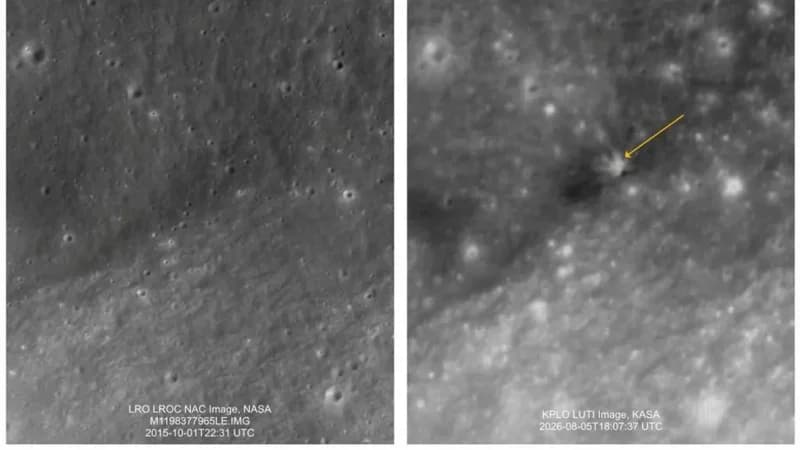
South Korea’s space agency, KASA, has released significant photographic evidence showing the aftermath of a SpaceX Falcon 9 rocket stage crashing into the lunar surface. The images, captured by the Danubri lunar orbiter, provide a rare look at the results of an unintentional collision between man-made debris and the Moon. The impact occurred at approximately 06:35 GMT on Wednesday, following a trajectory influenced by complex gravitational forces that eventually pulled the discarded hardware toward the lunar landscape.
The debris, identified as the upper stage of a Falcon 9 rocket and estimated to be the size of a five-story building, struck the Moon at a staggering speed of roughly 5,400 mph. According to statements from SpaceX, the impact was not a planned maneuver but rather the result of the empty rocket stage being left in orbit. While the rocket had been in space since January 2025 after a launch from Florida, its long-term path was dictated by the gravitational pull of the Earth, Moon, and Sun, eventually leading to this high-speed encounter.
Although the flash generated by the impact was too faint to be detected by amateur telescopes on Earth, KASA’s specialized lunar orbiter was able to document the site through before and after photography. These images are currently being analyzed by observatories and scientific teams to understand the geological impact on the lunar crust. The event serves as a stark reminder of the physical footprint human exploration is leaving beyond Earth’s atmosphere, even in areas intended to remain pristine.
The incident has reignited urgent discussions regarding the proliferation of space debris and the management of orbital waste. Astronomer Matt Bothwell has raised concerns that the space surrounding Earth and its satellite is becoming increasingly crowded, which could pose significant risks for future space exploration and satellite deployment. As the frequency of launches increases, experts warn that navigating Earth’s orbital space will become more complicated, necessitating more robust international protocols to manage discarded rocket components and prevent future unintended collisions.