••
Ministry of Education Overhauls Basic School Curriculum as New Research and Leadership Initiatives Launch at University of Ghana
•3 min read•5 sources
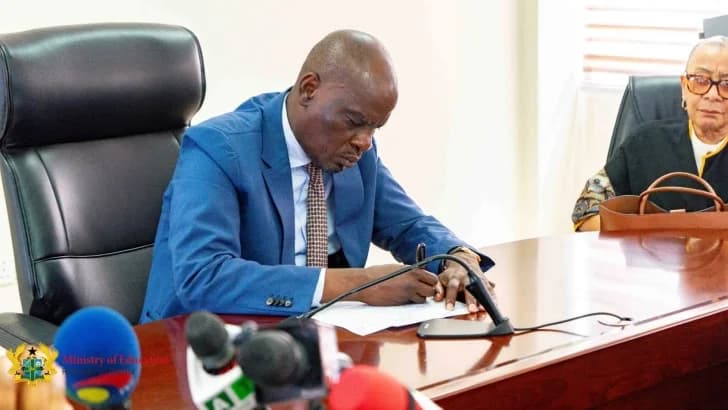
The Ministry of Education, under the leadership of Minister Haruna Iddrisu, has received a newly revised curriculum for kindergarten and primary education designed to modernize foundational learning across the country. Developed by the National Council for Curriculum and Assessment (NaCCA), the reform introduces 13 subject areas aimed at equipping pupils with 21st-century skills and global competitiveness. This milestone coincides with significant leadership changes and the launch of new policy initiatives within the academic sector, all focused on bridging the gap between classroom learning and the demands of the modern workforce.
A key feature of the revised curriculum is the earlier introduction of foreign language instruction, with pupils set to begin learning languages such as Chinese and Arabic as early as Primary One. The overhaul also integrates Computing into the Mathematics syllabus, reintroduces Citizenship Education to foster ethically responsible citizens, and shifts assessment methodologies toward task-based and formative standards. By adopting a play-based approach for early learners, the Ministry aims to reduce subject overload while ensuring children remain grounded in their native Ghanaian languages alongside English and other international tongues to enhance global preparedness.
Complementing these structural changes are new leadership appointments and research initiatives at the tertiary level. Professor Peter Quartey, a distinguished economist and former Director of the Institute of Statistical, Social and Economic Research (ISSER), has been appointed as the Provost of the University of Ghana’s College of Education, effective August 1, 2026. Additionally, the Policy Bridge Institute–Africa (PBI-A) was recently launched at the University of Ghana to address the persistent disconnect between academic success and job opportunities. Led by co-founder Dr. Loretta Bortey Kubate, the institute will focus on technology, innovation, and skills training to better prepare Ghanaian youth for the digital economy.
However, despite these curriculum advancements, prominent voices are calling for deeper investment in the research infrastructure that underpins educational success. Professor Kwabena Frimpong-Boateng, the former Minister of Environment, Science, Technology and Innovation, recently criticized successive governments for neglecting critical bodies like the Council for Scientific and Industrial Research (CSIR) and the Ghana Atomic Energy Commission. During a lecture honoring the late President John Evans Atta Mills, he warned that failing to provide consistent state funding for research forces institutions to rely on commercial activities for survival, contributing to a national brain drain. He emphasized that for Ghana to achieve sustainable economic transformation, the government must move beyond curriculum changes and commit to robust investment in innovation and scientific inquiry.
This story touches markets covered on Anansi Intelligence ↗.
More from education
Continue exploring similar stories


