••
Empowering Ghana’s Next Generation: Youth Innovators Leverage Robotics and Digital Skills to Tackle National Challenges
•2 min read•2 sources
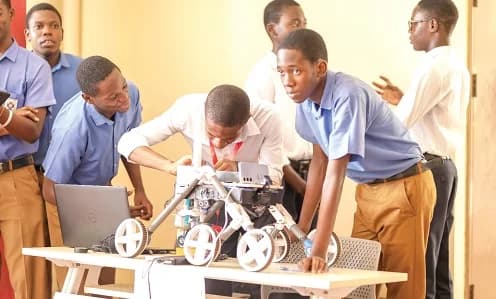
Ghana is witnessing a significant surge in youth-led technological innovation as students across various educational levels leverage robotics and digital skills to address pressing national issues. Two major events recently highlighted this trend: the annual Tech Expo organized by the Robotics Club of Academic City University, which focused on technological solutions to the illegal mining (galamsey) crisis, and the graduation of 500 students from the Telecel Foundation’s DigiTech Academy. These initiatives underscore a growing movement toward practical, technology-driven approaches to environmental restoration and industrial development.
At the Academic City Tech Expo, held under the theme “Innovating to Reverse the Effects of Galamsey and Restore the Earth,” students from top-tier institutions, including the University of Ghana, Ashesi University, and Presbyterian Boys' Secondary School, showcased projects designed to mitigate the damage caused by illegal mining. Prof. Elsie Effah Kaufmann, Dean of the School of Engineering Sciences at the University of Ghana, challenged participants to move beyond mere demonstrations and seek the resources necessary for implementation. The expo also featured a panel of experts, including Dr. Kenneth Ashigbey of the Ghana Chamber of Mines, who warned about the increasing violence associated with illegal mining and called for sustained, technology-backed interventions to reclaim the environment.
Complementing these high-level innovative efforts, the Telecel Foundation’s DigiTech Academy recently graduated its third cohort of 500 students from five regions. This 12-week intensive program provided training in coding, web design, and robotics, resulting in practical inventions such as automated irrigation systems and security alarms. To date, the academy has trained over 2,300 students in partnership with the Ghana Education Service, with a strategic emphasis on increasing female participation in STEM. By equipping younger students with foundational digital literacy, the program creates a pipeline of talent capable of contributing to the sophisticated environmental and economic solutions showcased at platforms like the Academic City Tech Expo.
The synthesis of these initiatives reflects a broader shift in Ghana’s educational landscape, where STEM subjects are being applied to real-world crises. Ezekiel Kpodo, President of the Academic City Robotics Club, emphasized that technology-driven approaches are no longer optional but necessary to reduce environmental degradation. As these young innovators continue to graduate and refine their prototypes, the focus of national authorities and private partners must now turn toward providing the capital and policy frameworks required to scale these local innovations into national solutions.
This story touches markets covered on Anansi Intelligence ↗.
Related topic
Ghana Education Service (GES): Latest News Today →More from technology
Continue exploring similar stories


