••
Corporate and Institutional Partnerships Transform Ghana's Classrooms through Infrastructure and Health Initiatives
•3 min read•21 sources
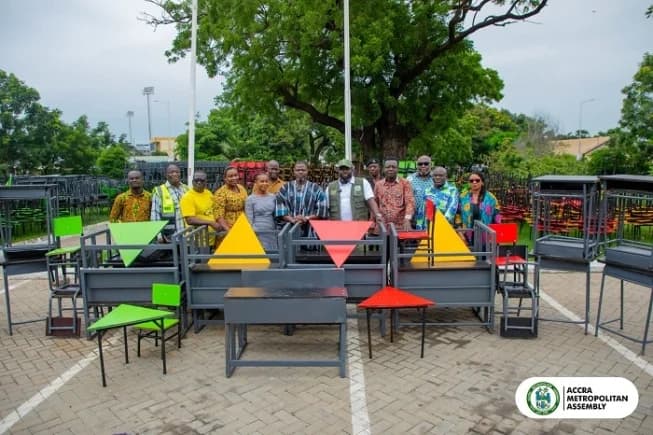
Ghana’s education sector has received a significant boost as several corporate bodies, government agencies, and non-governmental organizations launch a series of interventions aimed at improving school infrastructure, sanitation, and student health. From the Accra Metropolitan Assembly’s (AMA) furniture distribution to Fidelity Bank’s classroom renovations and the Ghana Chamber of Mines’ support for menstrual hygiene, these multi-sectoral efforts highlight a growing commitment to addressing the systemic challenges facing public basic schools across the country. By focusing on both physical environments and social barriers to education, these stakeholders are working to ensure that every Ghanaian child has access to a conducive and dignified learning space.
In terms of physical infrastructure, the Accra Metropolitan Assembly has distributed 997 school desks—including mono, dual, and hexagonal types—to eight public schools across the Okaikoi South, Ashiedu Keteke, and Ablekuma South sub-metros. Funded by the District Assemblies Common Fund, this initiative aims to remedy furniture shortages that have long hindered classroom activities. Simultaneously, Fidelity Bank Ghana commissioned the refurbishment of six classrooms and new sanitation facilities at the La-Bawaleshie Presby ‘2’ Basic School in Accra. This project marks the 14th school transformation under the bank’s Orange Impact Initiative, which seeks to enhance educational environments as part of its long-term commitment to national development.
Addressing health and sanitation, the "Purple Peach Project," a collaboration between Zijin Golden Ridge Limited and the Ghana Chamber of Mines, provided over 1,000 schoolgirls in the Birim North District with an eight-month supply of sanitary products and menstrual health education. The initiative aims to reduce absenteeism and combat the stigma associated with menstruation, which often prevents girls from attending school. In a similar vein, World Vision Ghana has launched the 7th edition of its School Sanitation Solutions (Triple S) Challenge. This nationwide essay competition, targeting students from Primary Six to JHS 2, encourages young people to propose sustainable behavioral changes and practical solutions to Ghana's sanitation challenges, with the winner being crowned as a Child Sanitation Diplomat in September 2026.
Community-level support also featured prominently with the De Mayor Foundation celebrating its first anniversary by donating essential educational materials to schools in the South Tongu District of the Volta Region. Beneficiary institutions, including Dalive–Torsikpota LA Primary and Agorta JHS, received exercise books, mathematical sets, and stationery to alleviate the financial burden on parents. These various interventions collectively signal a shift toward more holistic educational support, where infrastructure is paired with advocacy and health resources. As these organizations continue to partner with local education officials, the emphasis remains on creating sustainable improvements that foster student confidence and academic performance across Ghana.
This story touches markets covered on Anansi Intelligence ↗.
More from education
Continue exploring similar stories


