••
Ghana Unites for Massive National Clean-Up Following Devastating Floods; Government and Corporate Stakeholders Drive Post-Disaster Recovery
•3 min read•23 sources
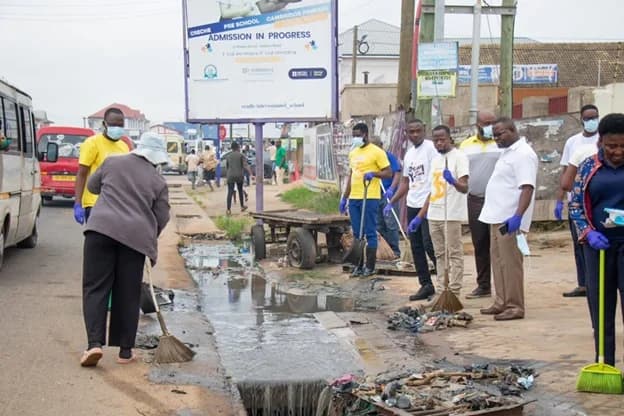
Following the devastating floods of June 29 that claimed at least 13 lives in Greater Accra, Ghanaians from all walks of life participated in a massive two-day National General Cleaning Exercise to mitigate future disasters. Initiated by the government, the exercise saw a historic mobilization of state agencies, security forces, corporate entities, and the entertainment industry. From the capital to regional centers like Ho and Sogakope, participants engaged in desilting choked drains, clearing refuse from public markets, and fumigating affected communities. The initiative was spearheaded by top leadership, including President John Dramani Mahama and Vice President Dr. Mahamudu Bawumia, who emphasized the importance of collective responsibility in maintaining environmental sanitation and public health.
Corporate and institutional support was a cornerstone of the operation's success. Zoomlion Ghana Limited deployed 2,000 personnel along with heavy equipment, including compaction trucks and fumigation teams, to reclaim communities. Meanwhile, organizations such as the Bui Power Authority, CalBank PLC, and Karpowership Ghana contributed both manpower and essential sanitation tools like wheelbarrows and refuse bins. Even the Narcotics Control Commission (NACOC) and the movie industry, led by figures like Selassie Ibrahim and Keche Joshua, joined the streets to clean public spaces. However, the exercise was not without friction; while many residents showed zeal, some corporate staff faced criticism for non-participation, and a viral video surfaced showing a soldier disciplining a citizen caught littering into a gutter during the clean-up.
Enforcement and infrastructure overhaul emerged as critical themes during the exercise. The Environmental Protection Authority (EPA) took decisive action by closing the Dukes Fuel Station in Kasoa after an inspection revealed that its silted drains were contributing to highway flooding. While the clean-up focused heavily on waste removal, environmental engineering expert Dr. Juliet Ohemeng-Ntiamoah cautioned that littering is only part of the problem. She argued that Accra’s recurrent flooding is primarily driven by inadequate drainage infrastructure and silt accumulation in waterways, calling for a total overhaul of the city's drainage systems to manage major flood events.
To ensure the sustainability of the efforts, the Ministry of Local Government, Chieftaincy, and Religious Affairs deployed 600 tricycles to evacuate the high volume of waste generated during the two-day period. Local leaders, including Ellembelle DCE Joseph Armah Agyekum, have called for the exercise to become a monthly or weekly mandatory event, alongside stricter enforcement of bye-laws against building on waterways. As organizations like MAREDES call for the establishment of a National Urban Disaster Recovery Fund, the exercise serves as a stark reminder of the urgent need for improved urban planning and climate resilience to prevent the recurring cycle of flood-related tragedies in Ghana.

