••
Kumasi Technical University Unveils "Nimde3 Hyiren REV" Self-Charging Electric Vehicle Prototype
•2 min read•1 source
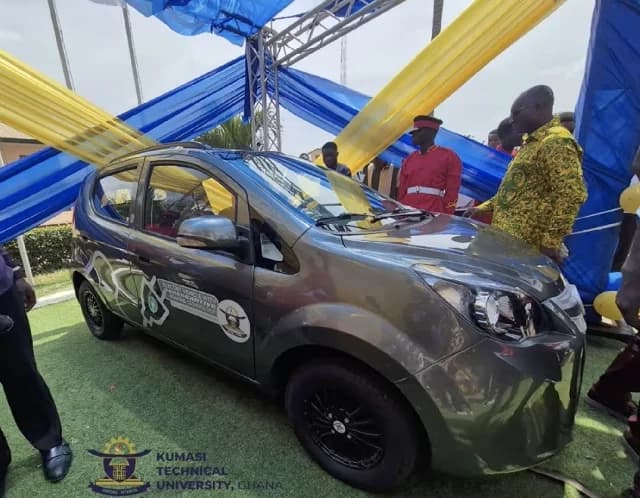
Kumasi Technical University (KsTU) has reached a significant milestone in Ghana’s drive toward sustainable transportation with the unveiling of its locally manufactured electric vehicle, the "Nimde3 Hyiren REV." Introduced during the climax of the university’s 70th-anniversary celebrations on March 28, 2026, the five-seater prototype represents a major breakthrough in home-grown automotive engineering. This innovation highlights the institution's capacity to transition from theoretical research to practical, industrial solutions that address modern environmental challenges while showcasing the ingenuity of the Ghanaian youth.
The development of the vehicle was spearheaded by a dedicated team of three final-year students who completed the project within a six-month window. Central to the "Nimde3 Hyiren REV" is its advanced regenerative braking technology, which effectively allows the car to recharge its batteries while in motion. This feature is particularly crucial for addressing "range anxiety," a common concern among potential electric vehicle users. According to Prince Owusu-Ansah, Head of the Automotive Department at KsTU, the prototype’s efficiency is proven, with the vehicle capable of traveling from Kumasi to Konongo without requiring an external charge, demonstrating its viability for inter-city travel within the region.
Beyond the technical achievement, the project underscores a broader vision for national industrialization. Vice-Chancellor Professor Gabriel Dwomoh emphasized that the university is committed to bridging the gap between academia and industry. While the prototype serves as a proof of concept, the university is now seeking strategic partnerships and financial support to transition into commercial production. Professor Dwomoh noted that with the right investment and infrastructure, KsTU aims to streamline its manufacturing processes, potentially delivering more efficient, custom-ordered vehicles within just six months of a request. This initiative not only positions the university as a leader in green technology but also offers a blueprint for how technical education can drive economic growth and self-reliance in Ghana.
This story touches markets covered on Anansi Intelligence ↗.
More from technology
Continue exploring similar stories


