••
Interior Minister Reports 12 Dead and Over 38,000 Displaced in Ghana’s Record-Breaking June Floods
•3 min read•5 sources
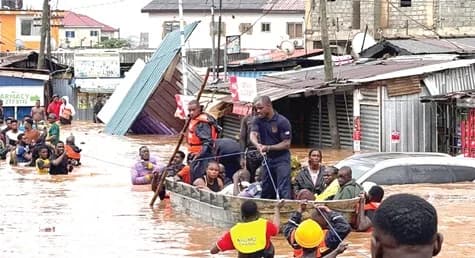
Ghana is grappling with the aftermath of catastrophic flooding that has claimed at least 12 lives and displaced 38,802 individuals across the country. Briefing Parliament on the disaster, the Minister for the Interior, Muntaka Mohammed-Mubarak, revealed that seven people remain missing following a series of torrential downpours that peaked on June 29, 2026. The floods have severely impacted 7,761 households across 18 metropolitan, municipal, and district assemblies (MMDAs) in the Greater Accra Region alone, disrupting economic activities and destroying property on an unprecedented scale. The Interior Minister extended the government’s condolences to the bereaved families, noting that the volume of rainfall recorded—169.2 mm in a single day—was the fourth highest since 1995.
The meteorological data highlights the historic nature of the disaster. Minister Mohammed-Mubarak stated that total rainfall for June reached 593.2 mm, making it the wettest month in Ghana's history and surpassing the previous record of 420.6 mm set in 2002. In Greater Accra, areas such as Korle Klottey, Tema, and Ayawaso Central were among the hardest hit, with Korle Klottey alone recording 6,500 displaced persons. Residents have expressed shock at the intensity of the water; Benjamin Lartey, a long-time resident of Adabraka, described the event as the worst he has seen in 40 years, noting that the water levels far exceeded those of the major disasters in October 1995 and June 2015.
Beyond the capital, the destruction of infrastructure has been extensive. In the Western North Region, the Wassa Amenfi Municipal Directorate of NADMO reported that approximately 100 buildings collapsed in Samreboi, with another 20 partially destroyed and over 1,200 residents displaced. The Central Region also saw significant damage, with 58 houses collapsing across various districts, including Cape Coast, where five people died due to building failures. While the Volta Region saw flooding in 60 communities, including Keta and Sogakope, officials noted that no life-threatening situations were reported there. In most affected areas, receding floodwaters have left behind significant structural damage and contamination risks, rendering many homes unsafe for immediate habitation.
As recovery efforts continue, the government has warned that the crisis may not be over. The Ghana Meteorological Agency (GMeT) has advised the Ministry of the Interior to prepare for more heavy rainfall throughout the remainder of June and into July. While the agency can predict rainfall, the Minister admitted that the "quantum of water" can be difficult to estimate until just before the events occur. Moving forward, the focus remains on providing relief to the nearly 39,000 displaced citizens and assessing the long-term structural integrity of buildings in flood-prone zones to prevent further casualties from secondary building collapses.
