••
Ghana Advances Industrial and Health Education through New Infrastructure and Specialist Training
•3 min read•4 sources
Ghana is intensifying its focus on specialized industrial and scientific education to drive economic growth and public health resilience. This strategic push is evidenced by a series of recent initiatives, ranging from high-level academic policy proposals at the Kwame Nkrumah University of Science and Technology (KNUST) to the commencement of a multi-million-euro industrial training hub and the successful completion of regional laboratory training for infectious diseases. These developments highlight a growing consensus between government, academia, and industry on the need for practical, skills-based education to address national challenges.
In a significant call for industrial reform, Professor Ebenezer Kofi Howard, Vice-Dean of the Faculty of Art at KNUST, emphasized the urgent need for a sustainable raw material base to revitalize Ghana's textile and apparel sector. During an inaugural lecture, Professor Howard revealed that over 70% of textiles are currently imported, leading to a decline in local production and employment. He proposed restructuring the National Cotton Development Authority and establishing an 'Industrial Dyes Park' to reduce import dependence. Supported by KNUST Vice-Chancellor Professor Rita Akosua Dickson, Howard suggested that leveraging petrochemical resources for synthetic fibers could position the garment sector as a major catalyst for economic growth, mirroring successes in nations like Vietnam and Bangladesh.
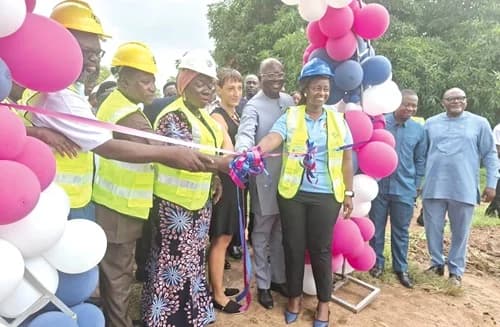
Simultaneously, the government has moved to bridge the skills gap in the manufacturing sector through the construction of the Integrated Industry Training, Entrepreneurship and Database Hub (ITAED-Hub). Inaugurated by the Minister of Trade, Agribusiness, and Industry, Elizabeth Ofosu-Agyare, the project is a collaborative effort between the Council for Scientific and Industrial Research (CSIR-IIR) and the Association of Ghana Industries (AGI). Funded by a €3 million grant from the Skills Initiative for Africa (SIFA), the hub will offer specialized training in cutting-edge fields including electric vehicles, smart engineering, and Computer-Aided Design (CAD). The facility is expected to be completed within 18 months, providing youth with the practical expertise necessary for modern industrial roles.
Complementing these industrial efforts, Ghana continues to serve as a regional center for medical excellence through specialized technical training. Eight laboratory professionals from Ghana, Liberia, Nigeria, Sierra Leone, Togo, and Zambia recently completed a rigorous training course at the Noguchi Memorial Institute for Medical Research (NMIMR). Held in partnership with the Japan International Cooperation Agency (JICA), the program focused on enhancing laboratory skills in parasitology, virology, and bacteriology. By fostering these advanced competencies, Ghana is not only strengthening its own educational and industrial framework but also contributing significantly to the broader public health capacity of the African continent.
This story touches markets covered on Anansi Intelligence ↗.
Live rates
Euro to cedi rate →More from education
Continue exploring similar stories


