Ghana News AI
HomeBriefsAsk GhanaAnalysisTopicsAbout
•
•

Stay Informed

Get AI-curated news briefs from Ghana delivered to your inbox every morning. Free forever, no spam.

Explore

  • Home
  • Briefs
  • About

Categories

  • Politics
  • Business
  • Sports
  • Entertainment
  • Africa

Features

  • Analysis
  • Cedi Rates
  • Dollar to Cedi
  • Ghana Gold Price

Topics

  • All Topics
  • Armed Forces Recruitment
  • Immigration Service Recruitment
  • Fire Service Recruitment
  • Prisons Service Recruitment
  • Customs Recruitment
  • WAEC Results & News
  • Ghana Education Service

Legal

  • Privacy Policy
  • Terms of Service
Ghana News AI© 2026 Ghana News AI. All rights reserved.
Made withfor Ghana
education

Galaxy International and Local Schools Achieve Academic Excellence in International and Civic Competitions

28th June•2 min read•2 sources
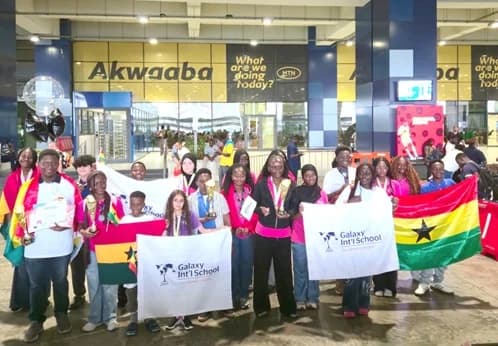
The team on their arrival at the Accra International Airport
  1. Home
  2. /Education
  3. /Galaxy International and Local Schools Achieve Academic Excellence in International and Civic Competitions

Ghanaian students have demonstrated exceptional academic prowess and civic dedication in June 2026, recording significant victories in both international and domestic arenas. While Galaxy International School secured a historic medal haul at the Owlypia International Competition in London, local basic schools within the Korle Klottey Municipality showcased their deep understanding of the 1992 Constitution during the National Commission for Civic Education (NCCE) Constitution Quiz. These dual achievements highlight a robust educational landscape in Ghana that balances global competitiveness with a strong foundation in national values and governance. On the international stage, Galaxy International School made history at the Owlypia International Competition held in London. Represented by a record 52 participants, the school clinched a staggering 41 medals, comprising 16 gold, 18 silver, and 7 bronze. Individual standouts included William Kofi Owusu Opong and Maryam Ruzmetova, who received top honors for their exceptional intellect. This performance not only underscored the school's commitment to academic rigor but also showcased Ghana's potential to nurture innovative young leaders capable of competing at the highest global levels. Locally, the NCCE Korle Klottey Municipal Office concluded its Constitution Week celebrations with a rigorous quiz competition aimed at fostering civic responsibility among basic school students. Liberty Avenue Two Basic School emerged as the overall winner, followed by All Saints Basic School in second place, while Adabraka Presbyterian and St. Barnabas Anglican Basic Schools shared the third position. The competition specifically tested students on various sections of the 1992 Constitution, including Chapter 19, challenging them to apply legal and civic knowledge to real-world contexts. Beyond the trophies and medals, these events served as platforms for critical mentorship and development. NCCE Municipal Director Mr. Jonathan E. Nii Adjiri Sackey utilized the local platform to urge students toward the responsible use of digital platforms, emphasizing that constitutional knowledge must be paired with ethical behavior in the digital age. Collectively, these successes suggest that Ghana's educational efforts are successfully preparing a new generation of citizens who are both globally minded and deeply rooted in the democratic principles of their nation.

Our Take

From the Team

Coming Soon

Our team will add key insights, trends, and actionable takeaways to help you stay informed faster.

This story touches markets covered on Anansi Intelligence ↗.

Live rates

Ghana gold price →

More from education

Continue exploring similar stories

Ghana’s Education Sector Faces Vision Crisis Amid Infrastructure and Leadership Concerns
education|Yesterday

Ghana’s Education Sector Faces Vision Crisis Amid Infrastructure and Leadership Concerns

Ghana's education sector is reportedly at a crossroads, with experts warning that the primary challenge facing the nation's schools is not a lack of resources, but a significant deficit in leadership vision and strategic direction. A critical assessment of the current administration under the Ministry of Education suggests that the system is drifting without a clear agenda to tackle long-standing systemic failures. This lack of urgency is seen as a major barrier to improving educational outcomes for millions of Ghanaian children who continue to navigate a struggling academic environment. The gravity of the situation is underscored by alarming statistics regarding basic school infrastructure. Data reveals that approximately 2.3 million children across the country currently lack desks, forcing many to learn in uncomfortable and undignified conditions. Furthermore, the sector is plagued by an inequitable distribution of teachers and a severe lack of adequate facilities, with many existing school buildings having gone without renovation for several decades. Critics argue that while the government often focuses on new projects, the neglect of existing infrastructure has created a widening gap in the quality of education available to students in different regions. To arrest this decline, education analysts are calling for a fundamental shift in policy and implementation. Proposed reforms include a comprehensive review of the Education Strategic Plan to ensure it aligns with modern realities and immediate needs. There is a strong recommendation for the Ministry to prioritize the renovation of dilapidated structures over the commencement of new construction projects. Additionally, implementing a targeted campaign focused on early-grade literacy is seen as essential for building a solid foundation for future academic success. Without these decisive actions and a clear, unified vision, the education system risks further marginalizing the very students it is meant to empower.

GAMI Headmaster Mr. David Yaw Ansah Advocates for Integration of Experiential Learning via Educational Excursions
education|Yesterday

GAMI Headmaster Mr. David Yaw Ansah Advocates for Integration of Experiential Learning via Educational Excursions

Mr. David Yaw Ansah, the Headmaster of God’s Angel Montessori International School (GAMI), has made a passionate call for educational institutions across Ghana to prioritize experiential learning by making excursions a core part of their academic curricula. Speaking during a recent school visit to the Achimota Forest, Mr. Ansah emphasized that moving beyond the traditional classroom setting is essential for providing students with a holistic education that bridges the gap between theoretical knowledge and real-world application. He noted that the integration of such field-based learning is critical for modern pedagogical development, ensuring that students gain a deeper understanding of their environment. During the excursion, Mr. Ansah highlighted how direct exposure to natural and professional environments significantly enhances a student's grasp of complex subjects such as Science and Social Studies. He noted that observing biological diversity or historical landmarks firsthand allows learners to internalize concepts that might otherwise remain abstract in a textbook. According to the Headmaster, these field-based experiences are not merely leisure activities but vital pedagogical tools that foster critical thinking, boost self-confidence, and spark a genuine interest in environmental conservation among young learners. This hands-on approach ensures that students can relate what they read to what they see in the physical world. The advocacy comes at a time when there is a growing global shift toward hands-on learning models. Mr. Ansah argues that when students are given the opportunity to interact with their surroundings, they develop a stronger sense of social responsibility and a better appreciation for nature. By embedding these trips into the school calendar, educators can create a more dynamic learning environment that caters to different learning styles, ensuring that students are not just memorizing facts but are developing the analytical skills necessary for success in the 21st century. This method encourages an active rather than passive form of education. In his concluding remarks, the GAMI Headmaster urged school administrators and curriculum developers to view excursions as an investment in the future of the Ghanaian student. He called for a deliberate effort to design structured educational tours that align with specific learning objectives, ensuring that every trip contributes meaningfully to the student's academic and personal growth. As schools look to produce well-rounded citizens, Mr. Ansah’s proposal serves as a reminder that the world outside the classroom is often the most effective laboratory for learning, shaping students into socially responsible and environmentally aware individuals.

Educational Milestones: Okyeame Kwame and Royal Diadem School Celebrate Student Success and Teacher Impact
education|Yesterday

Educational Milestones: Okyeame Kwame and Royal Diadem School Celebrate Student Success and Teacher Impact

The Ghanaian educational landscape is currently buzzing with graduation celebrations, highlighting the collaborative effort between parents, students, and educators in shaping the nation's future leaders. Recent ceremonies, ranging from international O-Level graduations to local basic education milestones, have underscored the critical importance of character development and the often-overlooked role of teachers in the academic journey. These events serve as a poignant reminder that academic success is a shared responsibility that extends beyond the classroom walls. Prominent Ghanaian musician Okyeame Kwame recently brought national attention to the value of educators following his daughter Sante Nsiah Apau’s O-Level graduation from Galaxy International School. In a public show of gratitude, the artist praised the school’s faculty for their significant role in his daughter's upbringing and academic achievements. His remarks resonated with many, as he emphasized that raising a child is a collective duty. By using his platform to acknowledge teachers—who are frequently sidelined in public celebrations of student success—Okyeame Kwame highlighted the profound influence educators have during a child's formative years. In a similar vein of celebration and reflection, Royal Diadem School held its 2026 graduation ceremony on July 26, honoring its Basic Education Certificate Examination (BECE) candidates. The event, which drew over 200 guests, featured cultural performances and an awards ceremony that recognized both high-achieving students and committed staff members. The Headmaster, Mr. Nichols Amevor, delivered a stirring address urging the graduates to carry the values of discipline, integrity, and academic excellence with them as they transition to Senior High School (SHS). Since its founding in 1992, Royal Diadem has grown to serve approximately 600 students, maintaining a focus on holistic development. As these students prepare for the next chapters of their educational careers, whether through international O-Levels or the national SHS system, the message from both the celebrity father and the school leadership remains consistent: academic results must be paired with strong moral character. The recognition of teachers at both Galaxy International and Royal Diadem School suggests a growing public consciousness regarding the need to support and appreciate the teaching profession. For Ghana’s youth, these graduation milestones represent not just an end to one phase of schooling, but the beginning of a journey where the values of integrity and hard work will be tested in higher academic and social spheres.

GES and GHS Launch Malaria Prevention Campaign to Safeguard Students' Academic Future
education|Yesterday

GES and GHS Launch Malaria Prevention Campaign to Safeguard Students' Academic Future

The Ghana Education Service (GES) has underscored the critical link between health and academic performance, describing the latest school-based malaria prevention campaign as a strategic investment in the nation’s future. In a joint briefing with the Ghana Health Service (GHS), the GES called for intensified efforts to protect children from malaria through the consistent use of Insecticide-Treated Nets (ITNs) and the uptake of malaria vaccines. This collaborative initiative aims to reduce absenteeism and improve cognitive outcomes by addressing one of the leading causes of illness among school-aged children across the country. Theresa Oppong Mensah, the National Coordinator for the GES, emphasized during the briefing that the success of the educational sector is intrinsically tied to the health of its students. She noted that malaria remains a significant barrier to learning, often causing students to miss school or struggle with concentration due to recurring bouts of the disease. "Health and education are interconnected," Mensah stated, highlighting that a child who is healthy and protected from malaria is far better equipped to succeed in the classroom. To combat this, the GES is advocating for a multi-pronged approach that combines the distribution of ITNs with the promotion of malaria vaccinations in eligible regions. A major focus of the campaign is the proper and consistent use of ITNs. The GES issued a stern warning against the misuse of these nets for unintended purposes, such as gardening or fishing, which undermines the primary goal of preventing mosquito bites. Families are urged to ensure that every net provided is utilized every night to maximize its protective benefits. Beyond simple distribution, the GES is calling for active community involvement to monitor net usage and educate parents about the life-saving benefits of the malaria vaccine. By fostering a culture of prevention, the service hopes to create a safer environment for children both at home and in school. As the campaign moves forward, the GES and GHS plan to integrate malaria education more deeply into the school curriculum and community outreach programs. The ultimate goal is to move beyond temporary interventions toward a sustainable model where malaria prevention becomes a daily habit for every Ghanaian household. By prioritizing these health measures today, the GES believes it is laying the foundation for a more resilient and educated workforce tomorrow, ensuring that no child’s potential is cut short by a preventable and treatable disease.

All
africa
business
education
entertainment
health
news
politics
sports
technology