••
Bank of Ghana Personnel Costs Surge to GH¢3.29 Billion Amidst Recruitment of Specialized Talent
•2 min read•1 source
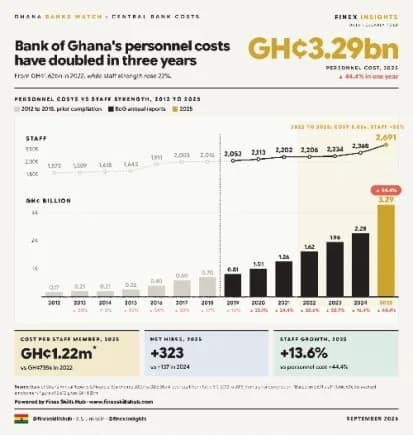
The Bank of Ghana (BoG) has recorded a significant spike in its personnel expenditures, with costs more than doubling over a three-year period to reach GH¢3.29 billion in 2025. According to the latest financial data, this represents a 103% increase from the GH¢1.62 billion recorded in 2022. This sharp rise in spending comes at a time when the central bank is navigating a complex economic landscape under the administration of President John Mahama, who assumed office in January 2025. Despite the massive jump in expenditures, the total number of staff at the central bank grew by a relatively modest 22% during the same period, rising from 2,206 in 2022 to 2,691 in 2025. The disparity between the growth in headcount and the surge in costs has been attributed to the central bank's strategic shift toward recruiting highly specialized talent. Specifically, the Bank has focused on attracting experts in technology and data analytics to modernize its operations, alongside the necessary replacement of retiring veteran employees. Personnel expenditures now account for approximately 63% of the Bank’s total operating expenses for 2025, a notable increase from the 56% share observed in 2024. Governor Dr. Johnson Asiama defended the rising costs, explaining that the Bank’s evolving mandate requires more hands and increasingly competitive remuneration to retain skilled professionals in a globalized labor market. He emphasized that these investments are essential for the central bank to maintain its regulatory efficacy and operational resilience in an era of rapid digital transformation. Looking ahead, the central bank expects a period of stabilization. Governor Asiama has projected a moderation in both recruitment and personnel cost growth, with a target to bring these expenditures down to no more than 40% of total operational costs in the coming years. Market analysts and stakeholders are now looking toward the next set of financial statements to determine if these cost-containment measures will take hold or if the trend of rising administrative overhead will continue to weigh on the central bank's balance sheet.
Related topic
John Mahama: Latest News & Updates →

