••
Auditor General Reports 3 Million Pupils Learning Under Trees as Local Authorities Push for Infrastructure Upgrades
•2 min read•4 sources
The 2025 Auditor General’s Report has revealed a staggering infrastructure deficit in Ghana’s basic education sector, with over three million pupils across 13 regions still learning under trees and in temporary shelters. This crisis involves more than 10,700 public basic schools that lack permanent classroom blocks, a situation the report identifies as a direct violation of the Pre-Tertiary Education Act of 2020. Despite long-standing national goals to eliminate "schools under trees," the report highlights worsening regional disparities, with some areas recording a Pupil-Classroom Ratio (PCR) exceeding 80 students per room, severely compromising the quality of teaching and learning.
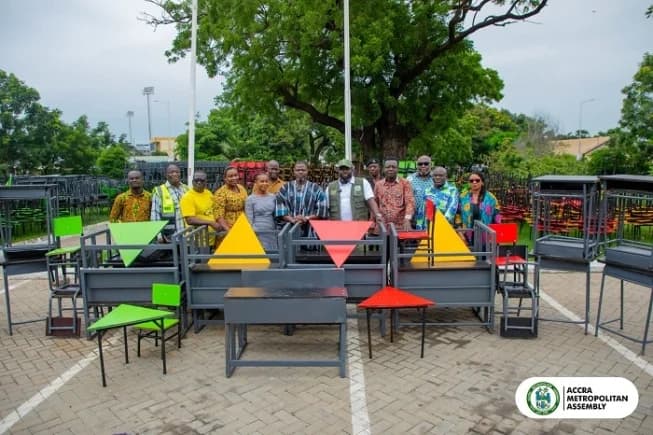
In response to these systemic shortages, local government authorities are taking steps to improve immediate learning conditions through targeted distributions and construction projects. In Accra, the Accra Metropolitan Assembly (AMA) recently distributed 997 desks—including mono, dual, and hexagonal styles—to eight public schools across the Okaikoi South, Ashiedu Keteke, and Ablekuma South sub-metros. Funded by the District Assemblies Common Fund (DACF), Municipal Chief Executive Michael Kpakpo Allotey emphasized that the initiative is part of a broader commitment to remedy furniture shortages and renovate school buildings to enhance the learning environment.
Progress is also being made in school construction, though the pace remains inconsistent across different projects. In the Ashanti Region, Regional Minister Dr. Frank Amoakohene recently praised Belco Heavy Machinery and Construction Limited for the rapid progress on the Agogoso D/A Primary School project, which reached 95% completion in just 12 weeks. This project is expected to significantly reduce classroom congestion in the area. However, the Minister also expressed concerns regarding delays at other sites, such as Nyinahin Senior High School, demanding weekly updates to ensure that infrastructure delivery meets the urgent needs of students.
Beyond physical classrooms and furniture, the drive for educational quality is increasingly focused on digital literacy to prepare students for a modern economy. Prof. Kingsley Nyarko, Member of Parliament for Kwadaso, has bolstered ICT capabilities in his constituency by donating advanced computer equipment to the Apatrapa Roman Catholic and Ohwimase Anglican Basic Schools. Each school received 15 desktop computers, projectors, and furniture. Prof. Nyarko urged the central government to prioritize digital infrastructure, noting that while physical classrooms are essential, ICT tools are fundamental to ensuring that public education remains competitive and relevant in the 21st century.
This story touches markets covered on Anansi Intelligence ↗.
More from education
Continue exploring similar stories


