••
Accra Technical University Launches New Business School Amid Growing Calls for Industry-Aligned Education
•2 min read•7 sources
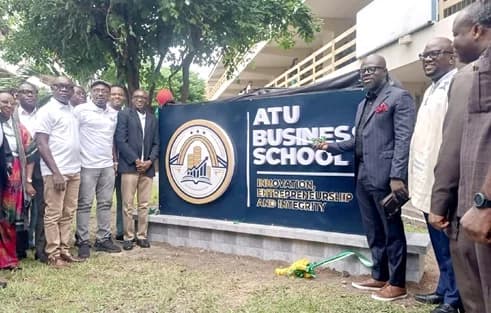
Accra Technical University (ATU) has officially renamed its Faculty of Business to the ATU Business School, marking a strategic shift toward advancing business education through innovation and disruptive technologies. At the unveiling ceremony, university leaders and industry experts emphasized that the move is more than a name change; it is a repositioning intended to align academic curricula with the rapidly evolving demands of the global corporate landscape. Chairman Prof. Ernest Kofi Abotsi and Vice-Chancellor Prof. Amevi Acakpovi articulated a vision for an industry-oriented institution that leverages artificial intelligence (AI) and strategic leadership to produce graduates capable of competing on an international scale.
Renowned marketing scholar Professor Robert E. Hinson, speaking at a symposium during the launch, urged Ghanaian business schools to bridge the persistent gap between academia and industry. He advocated for a research-intensive approach that incorporates emerging technologies like robotics and AI into marketing and procurement programs. Supporting this call for reform, Dr. Daniel McKellen proposed a comprehensive curriculum overhaul that prioritizes practical industry experience over traditional theory. This sentiment was echoed by the Dean of the new school, Prof. Elikem Ocloo, who reaffirmed the institution's commitment to academic excellence and strategic repositioning to meet regional and global standards.
The drive for practical business application is already yielding results in the student community, as seen in the recent Tertiary Business Sense Challenge (TBSC). The Kwame Nkrumah University of Science and Technology (KNUST) secured the top spot in the North-Mid Zonal Finals held in mid-July 2026, qualifying for the national finals alongside the University of Energy and Natural Resources (UENR) and Tamale Technical University (TaTU). The competition, which tests students on finance, accounting, and real-world business scenarios, serves as a critical platform for moving beyond rote memorization and preparing students for the rigors of the corporate world.
Complementing these academic and competitive shifts, the Bank of Ghana (BoG) has introduced the MPC Educational Observership Programme to demystify monetary policy for university students. Launched during the 131st Monetary Policy Committee meeting by Dr. Johnson Asiama, the initiative provides students—starting with the University of Ghana—direct exposure to the processes behind policy rate setting and inflation management. Collectively, these developments across ATU, the TBSC competition, and the central bank signal a coordinated effort to strengthen the connection between Ghana’s educational frameworks and the practical realities of the national and global economy.
This story touches markets covered on Anansi Intelligence ↗.
Live rates
Bank of Ghana policy rate →More from education
Continue exploring similar stories


