••
Interior Minister Reports 12 Dead and 38,800 Displaced as Historic Floods Ravage Greater Accra
•3 min read•26 sources
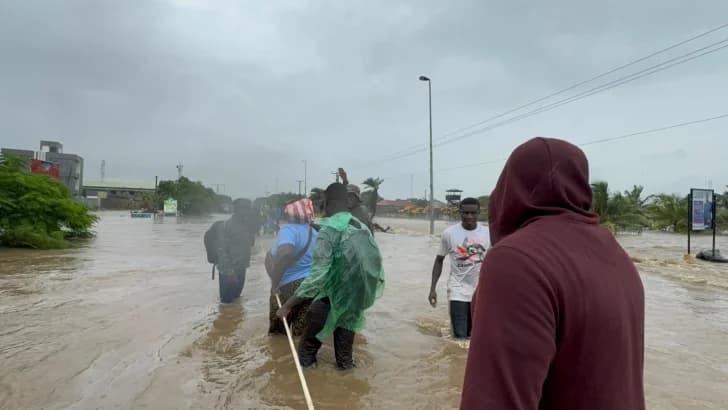
Ghana’s Minister for the Interior, Mohammed Muntaka Mubarak, has confirmed that at least 12 people have died and seven others remain missing following catastrophic flooding that has devastated the Greater Accra Region. Briefing Parliament on the disaster, the Minister revealed that the torrential rains displaced 7,761 households and affected a total of 38,802 individuals across 18 Metropolitan, Municipal, and District Assemblies (MMDAs). The floods, described as some of the most severe in the nation's history, were triggered by record-breaking rainfall in June, which saw a total volume of 593.2 millimeters—the highest ever recorded in Ghana for a single month. On the peak day of the deluge, Accra received 169.2 millimeters of water, the fourth-highest daily volume since 1995.
The human toll of the disaster was underscored by several tragic incidents, including the discovery of a lifeless body—identified by some reports as a teenage girl under 15—trapped inside a commercial minibus, or trotro, in Alajo after floodwaters receded. Beyond the capital, the Central Region also suffered significant damage, with 58 houses collapsing and additional fatalities reported due to building failures and drowning in Cape Coast, Mfantsiman, and Gomoa Central. In the Volta Region, approximately 60 communities were impacted, while over 1,200 people were displaced in Samreboi within the Western North Region. The Minister noted that while the Ghana Meteorological Agency (GMeT) had warned of heavy rains, the sheer volume of water overwhelmed existing drainage systems and infrastructure.
The flooding has caused widespread disruption to essential services and infrastructure. The Public Utilities Regulatory Commission (PURC) monitored significant power outages after GRIDCO and the Electricity Company of Ghana (ECG) were forced to shut down the Mallam and Achimota primary substations for safety reasons. In the Weija-Gbawe Municipality, the National Disaster Management Organisation (NADMO) issued an urgent evacuation order for residents living near the Weija Dam spillway as water levels reached critical heights, necessitating the opening of three spill gates. Meanwhile, commuters and motorists have decried the deteriorating state of roads in areas like Avenor, where stagnant water and deep potholes have made navigation hazardous.
In response to the crisis, the government has allocated GH₵300 million for relief efforts and ongoing search and rescue operations. NADMO, in partnership with Zoomlion Ghana Limited, has launched an intensive drain-clearing exercise under the "No Do No Do" campaign to mitigate further risks. Officials have emphasized that human activities, particularly improper waste disposal, contribute to roughly 50% of the flooding issues, a sentiment echoed by management at Laboma Beach who reported massive amounts of waste washing onto the shore. As the rainy season continues through July, the government has expressed its condolences to the bereaved families and pledged to enhance national disaster preparedness to prevent future recurrences of such magnitude.
