Understanding Ghana's Q2 2026 GDP Figures: What the Numbers Really Mean
A sector-by-sector reading of the Ghana Statistical Service's latest data, from the fishing slump and forestry's surprise rebound to the ICT engine powering national growth.
By Eddie Forson · 26 September 2026 · 11 min read
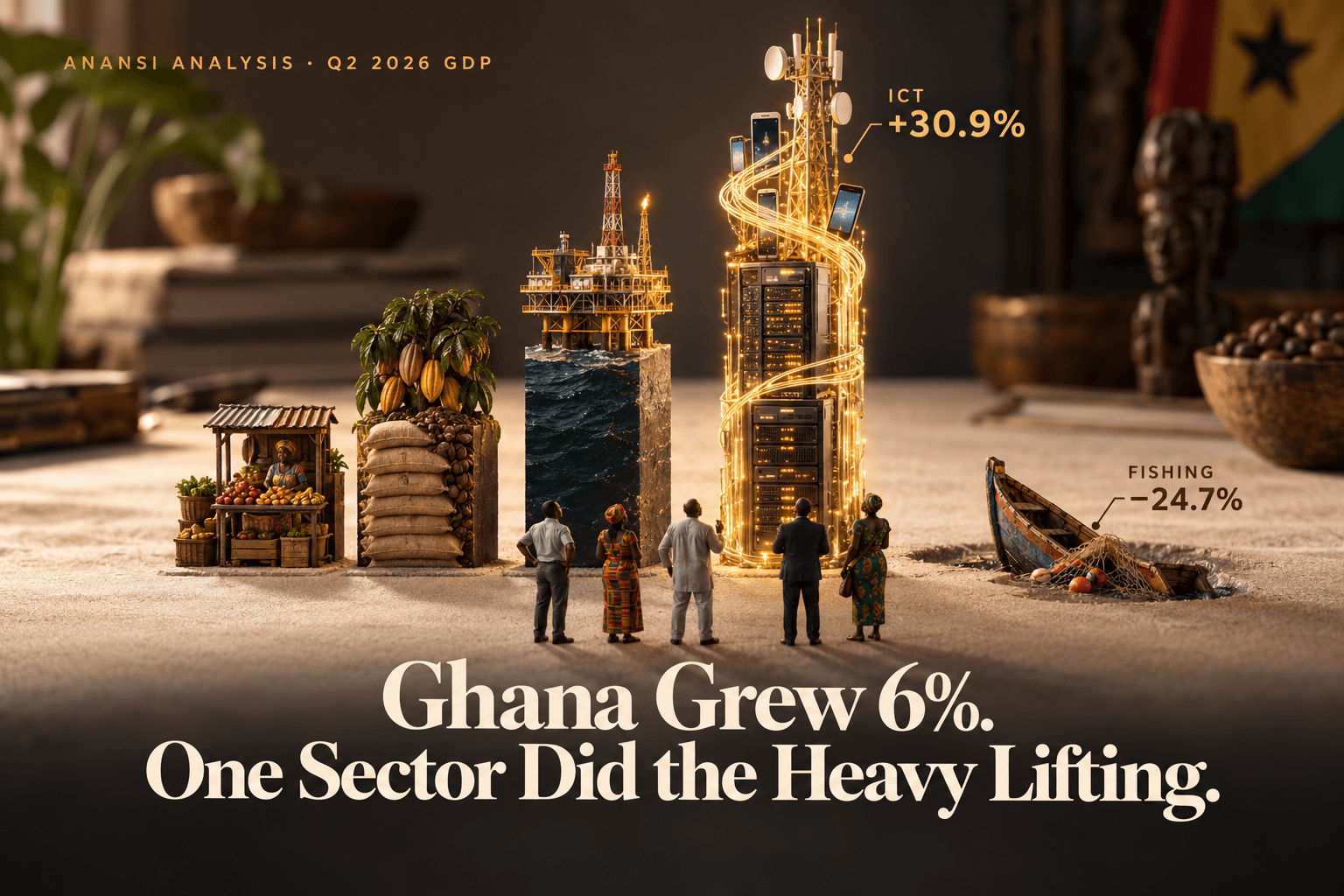
The Ghana Statistical Service (GSS) has published the Gross Domestic Product figures for the second quarter of 2026, and on the surface the story is a reassuring one: the economy is still growing at a healthy clip. But a headline number, however comforting, is a blunt instrument. It tells you the temperature of the room without telling you which windows are open and which radiators are broken.
That is the gap this analysis sets out to fill. The GSS report is factual and dispassionate by design. Our job here is to go beneath the aggregate, sector by sector and sub-sector by sub-sector, to explain what actually happened between April and June of this year, and why. Why did the fishing industry shrink even as the wider farming economy grew? Why did forestry and logging, of all things, post double-digit expansion? And how did Information and Communication Technology come to account for such an outsized share of the country's entire growth?
For the millions of Ghanaians living through this economy, and for the diaspora watching from abroad and often sending money home, these questions are not academic. They shape jobs, prices, the cedi in your pocket, and the confidence of investors deciding whether Ghana is a place to build. Let us take a deeper dive.
Macroeconomic Snapshot: A Sectoral Breakdown of Ghana's Q2 Performance
According to the Ghana Statistical Service, Ghana's economy grew by 6.0% year-on-year in real terms during Q2 2026. That is a solid result, though slightly slower than the 6.6% recorded in the same quarter of 2025. In nominal terms, the GSS valued the economy at GH¢372.1 billion, an 11.4% increase on the previous year.
The composition of that growth matters as much as its size. Services remained the largest single part of the economy, contributing 45.9% of GDP and, strikingly, 57.6% of overall growth, according to the GSS. Industry grew by 4.3%, helped by a rebound in the oil and gas sub-sector. Agriculture expanded by 3.9%, a marked deceleration from the 7.1% growth of Q2 2025, a slowdown the GSS attributes largely to a sharp contraction in fishing.
But the single most important fact in the report is where the growth came from. Information and Communication Technology alone accounted for 41.5% of total economic expansion in the quarter, per the GSS. In other words, a single sub-sector did more heavy lifting than the entire agricultural sector. That is a profound statement about where the Ghanaian economy is heading.
When one sub-sector drives more than four-tenths of national growth, the economy becomes both dynamic and dependent. ICT's rise is genuine good news, but it also means diversification, or the lack of it, will define Ghana's resilience over the next decade.
The table below summarises the headline sectoral picture from the GSS Q2 2026 release.
| Sector / sub-sector | Q2 2026 performance | Note |
|---|---|---|
| Overall GDP (real, YoY) | 6.0% | Down from 6.6% in Q2 2025 |
| Overall GDP (nominal value) | GH¢372.1 billion | 11.4% increase YoY |
| Services (share of GDP) | 45.9% | Largest sector; 57.6% of growth |
| Industry | 4.3% | Aided by oil and gas rebound |
| Agriculture | 3.9% | Down from 7.1% a year earlier |
| Manufacturing | 6.6% | Within Industry |
| ICT | 30.9% | 41.5% of total growth |
| Forestry and logging | 10.7% | Within Agriculture |
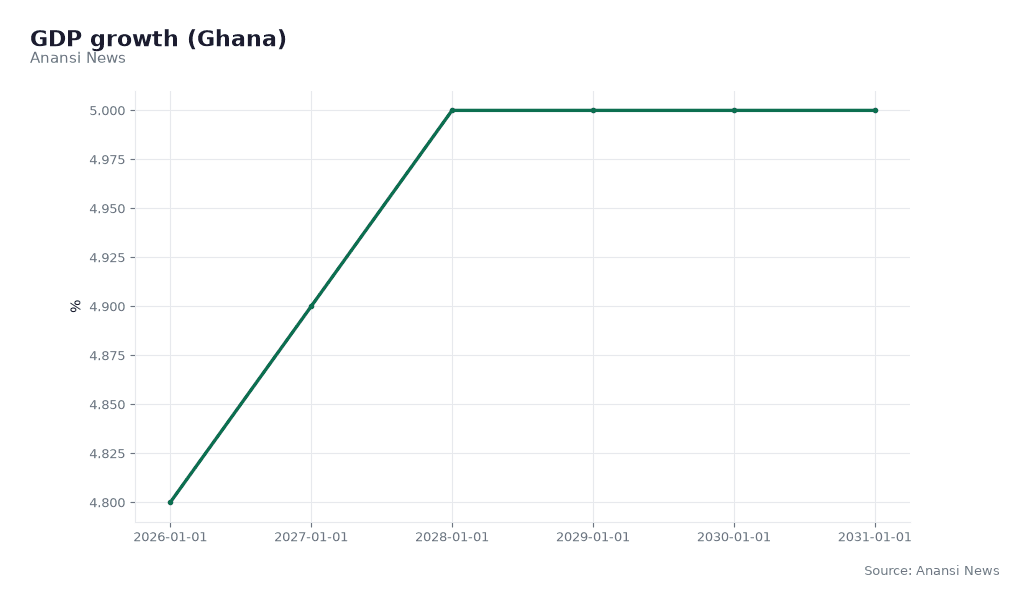
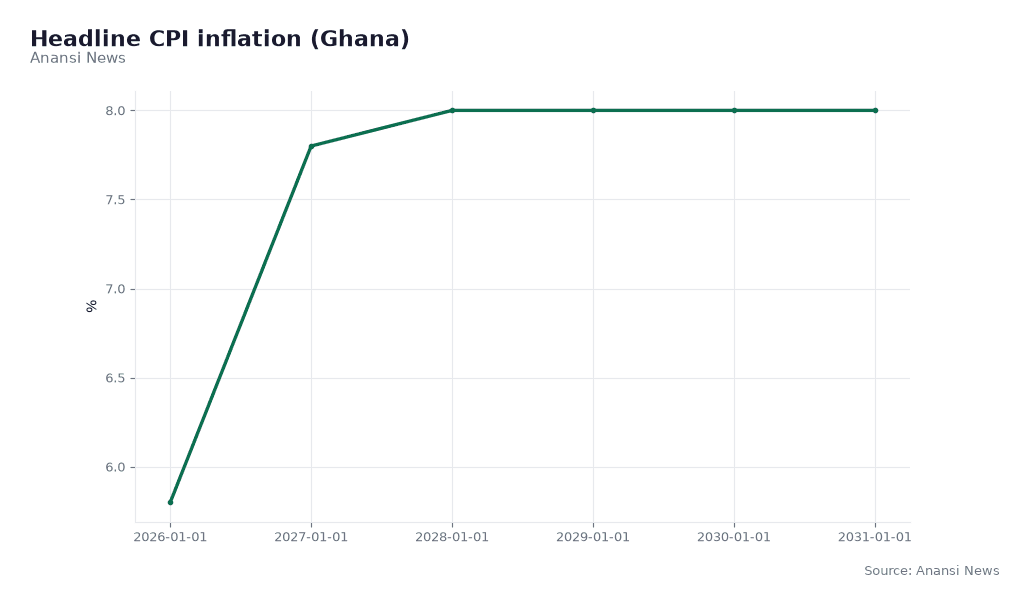
Set against the broader macro backdrop, the GDP data reads more coherently. GDP growth in Ghana stands at 5.0%, unchanged from the prior reading at 5.0%, a change of +0.0 pp. Inflation, meanwhile, sits at 8.0%, also unchanged from the prior 8.0%, a change of +0.0 pp. A growing economy with contained price pressure is, in principle, the combination policymakers dream of.
The commodities that underwrite Ghana's export earnings were broadly firm around the time of the release. Cocoa traded at $5,511 per tonne, up +1.4% from $5,436. Crude oil sat at $91.61 per barrel, up +0.5% from $91.11. Gold eased to $4,329 per ounce, down -1.0% from $4,374. The cedi was essentially flat at 11.55 to the dollar against a prior 11.56, a change of -0.0%.
Agriculture's Divergence: Analyzing the Fishing Slump and Forestry's Rise
Agriculture's headline 3.9% expansion is a textbook example of why aggregates deceive. The GSS describes a "sharply divided" sector: crops and livestock grew, but the whole was dragged down by a heavy contraction in fishing. Understanding that split is essential to understanding the quarter.
Start with fishing, which contracted sharply, according to the GSS. The cause is not mysterious, nor is it primarily a story of economic distress. It is a story of deliberate policy. The Ministry of Fisheries and Aquaculture implemented the 2026 Closed Fishing Season, which prohibited industrial trawlers from fishing during July and August and semi-industrial vessels during July. A closed season is, by definition, a period of reduced commercial catch, so a dip in measured output is the mechanical consequence of a conservation choice.
There is a second, structural driver. As reported by Mongabay, the Fisheries and Aquaculture Act, 2025 (Act 1146) expanded the Inshore Exclusion Zone from 6 to 12 nautical miles, effectively pushing industrial vessels further offshore to protect artisanal breeding grounds. In the short run this reduces commercial output; in the longer run it is designed to rebuild fish stocks that years of overfishing have depleted. The Q2 contraction, then, is partly the price of a bet on future sustainability.
Fishing supports coastal livelihoods from Elmina to Keta, and fish is a dietary staple. A policy-driven contraction is more manageable than a collapse in stocks, but the near-term squeeze on fishing communities and on the price of protein is real, and worth watching as the closed season lifts.
Now the surprise. Forestry and logging expanded by 10.7%, per the GSS, the kind of number that demands explanation. Two forces appear to be at work. First, the government's Tree for Life Reforestation Initiative 2026, which the Ministry of Lands says targeted the planting of 30 million trees, has channelled activity and investment into the sub-sector. Second, and more immediately, trade data cited via Fordaq shows that while primary wood exports dipped, overseas plywood exports surged, rising from 624 m³ in early 2025 to 7,099 m³ in 2026, driven by demand from the U.S. and European markets. Value-added processing, in short, is doing what raw exports could not.
That distinction, between shipping raw logs and shipping finished plywood, is exactly the industrialisation story Ghana has been trying to write for years. Forestry's quarter is a small proof of concept.
The crops sub-sector, including cocoa, remained the ballast of agriculture. With cocoa prices firm at $5,511 per tonne, the incentive structure for farmers is more favourable than in the lean years, even as bodies such as Fairtrade Africa continue to press the industry on closing the living income gap for farmers.
The Industrial Pulse: Manufacturing Movements and Productivity Shifts
Manufacturing recorded 6.6% year-on-year growth in Q2 2026, according to the GSS, comfortably above the overall agricultural rate and a genuine bright spot within the Industry sector, which itself grew 4.3% on the back of an oil and gas rebound.
What drove manufacturing? The evidence points to food processing. As reported by the USDA, the food processing sub-sector has attracted increased investment following government policies to promote local value addition, alongside rising consumer demand for convenience foods. This is the same theme visible in forestry, moving up the value chain rather than exporting raw inputs, and it aligns with the message from initiatives encouraging young Ghanaians to see opportunity across the agrifood value chain in processing, mechanisation and distribution rather than farming alone.
Yet the growth came against real friction. The Association of Ghana Industries (AGI), in its Q2 2026 Business Barometer, identified high electricity costs, cited by 19% of firms, and raw material prices, cited by 14%, as the primary challenges stifling faster expansion. In plain terms, factories are growing despite their cost base, not because of it.
A sector that expands while absorbing high energy and input costs is showing underlying demand strength. If power tariffs stabilise and the cedi holds near 11.55 to the dollar, the same firms could convert survival-mode growth into something more emphatic. Energy policy, not demand, is the binding constraint to watch.
The macro environment offers manufacturers some relief. A stable cedi lowers the local-currency cost of imported machinery and raw materials, and contained inflation at 8.0% protects consumer purchasing power for the processed goods these factories sell. The vulnerability is energy: until the cost and reliability of power improve, manufacturing's ceiling stays lower than its potential.
The Services Engine: Unpacking the ICT Boom and Sub-Sector Laggards
If there is one number that defines Q2 2026, it is this: the ICT sub-sector grew by 30.9%, according to the GSS, and accounted for 41.5% of all economic growth in the quarter. Services as a whole grew by 8.0%, but the GSS itself frames it as "a tale of two sub-sectors."
The ICT surge is built on the digitalisation of everyday Ghanaian life. As reported by the Bank of Ghana, mobile money transaction values reached GH¢518.8 billion by August 2026, a 46.5% year-on-year increase. Data consumption, in the GSS's own words, has become "the story of the economy." Every mobile money transfer, every streamed video, every online purchase now registers as economic activity, and the sheer velocity of that activity is what pushed ICT to the front of the pack.
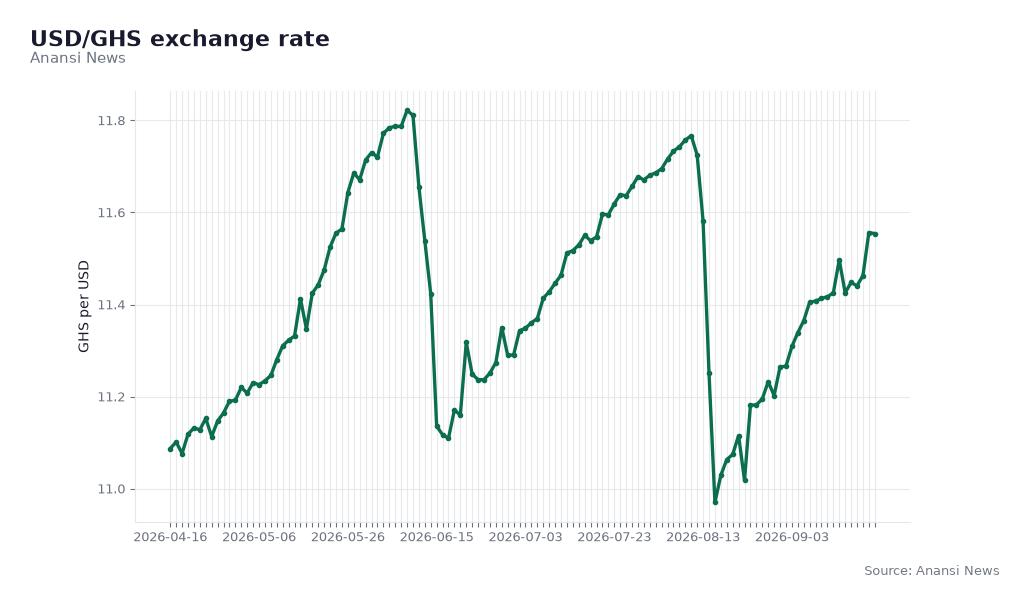
A steady cedi through the period gave digital and import-reliant service firms a calmer planning environment. Source: Anansi News.
ICT growth is not just a statistic, it is financial inclusion in action. Mobile money has brought millions of Ghanaians into the formal economy, and it underpins the remittance flows that connect the diaspora to families at home. The flip side, flagged in recent reporting on platforms like TikTok being used for fraud in Accra, is that rapid digital adoption widens the surface for scams, making trust and cybersecurity central to sustaining the boom.
But the "two sub-sectors" framing is a warning as much as a celebration. Not every service line prospered. According to the GSS, Accommodation and Food Services contracted in the quarter, while Public Administration and Education also shrank. Analysis from the IC Group attributes these declines to an "aggressive fiscal squeeze" on public sector activities, alongside a normalisation of demand following the real-wage gains that came as inflation cooled.
That fiscal squeeze is the hidden hinge of the quarter. The same discipline that has helped bring inflation down to contained levels has a cost: when the state spends less, public administration and education activity contract, and households that had briefly enjoyed stronger real incomes pull back on discretionary spending like hotels and restaurants. Stability, in the short run, is not free.
The ICT and mobile money boom is the infrastructure that makes sending money home faster and cheaper than ever. But the contraction in hospitality is a signal for anyone planning to invest in tourism or restaurants back home, demand has softened, and timing matters.
Looking Toward Q4: 2026 Economic Forecasts and Temperature Check
So what does Q2 tell us about where Ghana ends the year? The overall temperature is best described, in the phrase used by AIAIG, as one of "distressed reversal": a hard-won turnaround in which inflation has fallen sharply while the economy keeps expanding.
The near-term catalyst is oil. As noted by the IC Group, analysts expect growth to re-accelerate in the second half of the year as new oil wells from the Jubilee field expansion come online. With crude at $91.61 per barrel, a production ramp-up would flow directly into industrial output and export earnings in Q3 and Q4.
The forecasts themselves, however, diverge sharply, which is itself informative.
| Forecaster | Full-year 2026 growth projection |
|---|---|
| Ministry of Finance | ≥4.8% (official target) |
| International Monetary Fund | 4.8% |
| IC Group | 6.4% ± 0.5% |
The Ministry of Finance maintains an official target of at least 4.8% for the full year, per its 2026 Mid-Year Fiscal Policy Review, even though the economy is currently outperforming that goal. The IMF projects full-year growth of 4.8%. The IC Group is markedly more optimistic, forecasting 6.4% ± 0.5%, citing strong investment momentum and anticipated holiday spending in Q4.
The gap between the roughly 4.8% cluster and IC Group's 6.4% is essentially a debate about momentum versus caution. The official and IMF figures build in the drag from fiscal consolidation and the risk that ICT's blistering pace moderates. IC Group is betting that oil, investment and festive-season consumption keep the engine hot.
Three variables will settle the argument. First, whether the Jubilee expansion delivers oil on schedule. Second, whether the fiscal squeeze deepens the contraction in public administration and hospitality or eases. Third, whether ICT can sustain 30.9% growth or reverts toward a more ordinary pace. There is also a live weather risk, with the Bagré Dam spillage in Burkina Faso raising the prospect of flooding downstream in Ghana, a reminder that agriculture's recovery is not guaranteed.
The honest verdict is that Ghana enters the second half of 2026 in a fundamentally sound position: growing near 6.0%, with inflation contained at 8.0%, a stable cedi at 11.55, and firm prices for its key exports. The economy is not without stress, the fishing contraction, the fiscal squeeze on public services, and manufacturing's cost burden are all real. But these are the strains of an economy that is being actively steered toward stability, not one in freefall. The task for the rest of the year is to convert a strong quarter into a durable trajectory, and to make sure the growth that ICT is generating reaches beyond the digital economy into the farms, factories and fishing communities that still employ most Ghanaians.
Sources: Anansi market data, Anansi News newsroom.
Cite us / embed this
Reusing a chart or stat? Please credit Anansi News and link back to this page.
Sources: Anansi market data, Anansi News newsroom.
Charts
Sources
- 1.citinewsroom.com
- 2.theghanareport.com
- 3.ic.africa
- 4.kpmg.com
- 5.kpmg.com
- 6.cedehq.com
- 7.tradingeconomics.com
- 8.Anansi market data. Headline CPI inflation (Ghana)
- 9.Anansi market data. GDP growth (Ghana)
- 10.Anansi market data. Cocoa price
- 11.Anansi market data. Crude oil price
- 12.Anansi market data. Gold price
- 13.Anansi market data. USD/GHS exchange rate
- 14.Anansi News. Anansi News newsroom coverage