Galamsey in Ghana: How Illegal Mining Went From Ancestral Craft to National Emergency
A historical and economic analysis of Ghana's illegal small-scale gold mining, from pre-colonial pits to the poisoned rivers and record gold tonnage of the 2020s.
By Eddie Forson · 3 July 2026 · 13 min read
In the forests of Ghana's Ashanti and Western regions, the sound is unmistakable: the low grind of excavators clawing at riverbanks, the hiss of high-pressure hoses cutting into hillsides, the sluice boxes rattling as men wash gravel for flecks of gold. This is Galamsey, the Ghanaian shorthand for illegal, unlicensed small-scale mining. The word is a corruption of the English phrase "gather them and sell," and it captures something essential about the practice: it is at once an old, hand-to-mouth livelihood and, increasingly, an industrialised, financed and politically protected assault on the country's land and water.
Galamsey is not a fringe problem. It has hollowed out river systems that supply drinking water to millions, poisoned farmland in the heart of the cocoa belt, and drawn in tens of thousands of young Ghanaians for whom a shovel and a plot of forest represent the fastest route to cash in a punishing economy. It has also become a paradox. As global gold prices climb, small-scale output has surged to record levels, propping up the country's foreign reserves even as the same activity degrades the natural capital on which Ghana's longer-term prosperity depends.
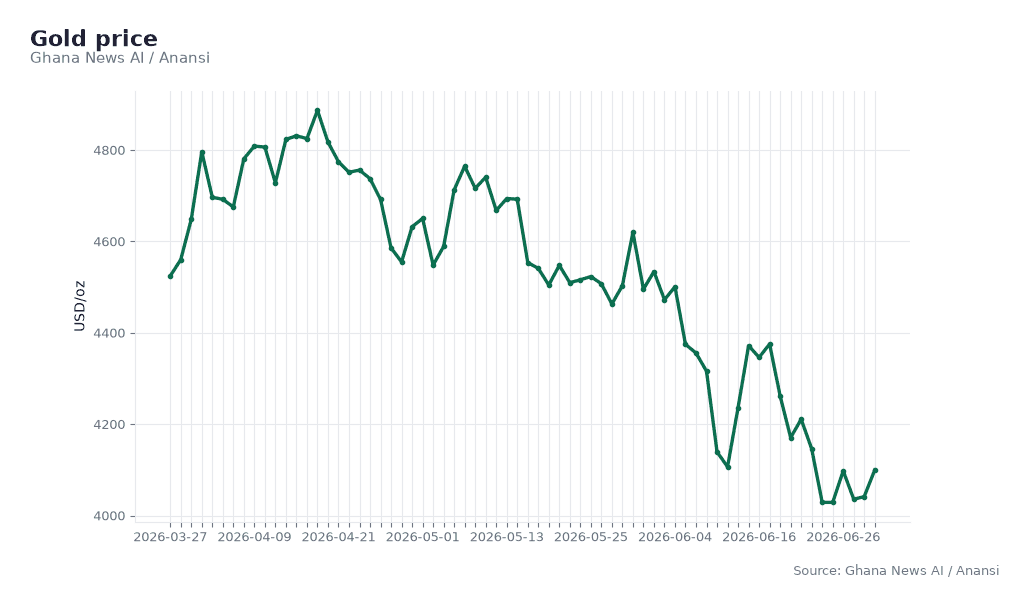
For a diaspora that sends money home and for investors weighing Ghana's sovereign brand, understanding Galamsey means understanding the collision of history, poverty, policy failure and world commodity markets. Gold traded at $4,100 an ounce at the start of July 2026, up +1.4% from the prior day's $4,042, according to market data. Every dollar of that rally is an incentive pulling more Ghanaians toward the pits. This analysis traces how the practice evolved, why successive governments have failed to stop it, and what a durable solution might look like.
The Evolution of Galamsey: From Traditional Craft to Industrial Crisis
Small-scale gold mining in the territory that became Ghana predates the colonial encounter by centuries. The medieval kingdoms of the region traded gold across the Sahara, and the very name Europeans gave the coast, the Gold Coast, testified to the metal's abundance. Long before mechanised concessions arrived, communities panned alluvial gold from riverbeds and dug shallow pits using family labour, seasonal and low-impact, woven into the rhythm of farming.
For most of the twentieth century this artisanal tradition sat awkwardly alongside the large, foreign-owned deep mines that dominated formal production. Colonial and post-colonial mining law was written around industrial concessions; the small digger was largely invisible to the statute book, neither fully legal nor systematically policed.
The transformation from craft to crisis is a story of technology and capital. What was once a pick-and-pan pursuit has become a mechanised operation built around excavators and the floating dredging platforms Ghanaians call "changfan" machines. These devices allow a small crew to move and wash volumes of earth that would have taken a village a season. The scale is now industrial even where the licence, if any exists, is for "small-scale" work.
The shift from hand tools to heavy machinery is the single most important fact about modern Galamsey. It is what turned a sustainable ancestral practice into an activity capable of killing a river in a matter of months.
Policy and Prohibition: Successive Government Interventions Since 1989
Ghana's modern legal architecture for small-scale mining begins in 1989. According to legal analysis of the framework, the Small-Scale Gold Mining Law of that year, PNDCL 218, was the first attempt to legalise and regularise the sector specifically for Ghanaians. Its instinct was inclusion rather than deterrence: it focused on registration, and its penalties amounted to minor fines or short prison terms.
The posture hardened dramatically over the following decades. The Minerals and Mining Act of 2006 (Act 703), as amended in 2019 by Act 995, replaced that light touch with heavy criminal deterrence. According to the amendment, penalties for illegal mining were raised to a minimum of 15 years and a maximum of 25 years imprisonment. Crucially, the newer law explicitly authorised the confiscation and destruction of equipment, excavators and changfans alike, a power the 1989 law never granted. It also singled out foreign participation for stiffer treatment, with fines up to 300,000 penalty units and mandatory deportation after jail.
Legislation, though, is only as strong as its enforcement, and enforcement has increasingly taken military form. Operation Vanguard, launched in July 2017, deployed 400 personnel, split evenly between military and police. According to a Danish Institute for International Studies (DIIS) analysis and related reporting, the task force destroyed over 6,000 changfan machines, removed roughly 90% of excavators from active sites by 2018, and made hundreds of arrests, at least 347 in its first year. Yet the military component was withdrawn in March 2020, undone by persistent corruption allegations over missing seized excavators, political resistance from local stakeholders, and its inability to touch the underlying poverty that drives participation.
Operation Halt followed in April 2021, targeting "red zones," the forest reserves and water bodies most under threat. According to the same body of research, it repatriated over 700 foreign nationals, roughly 70% of them Chinese, and destroyed equipment in situ. Far from fading, the operation was intensified through 2024 and 2025, evolving across three phases. According to the Ministry of Defence's 2026 budget estimates and the Africa Leadership Index, the government declared a "state of emergency" in Galamsey-ravaged districts in 2025 and deployed over 4,500 personnel.
The pattern is a cycle of "ban and burn." Governments announce crackdowns, torch equipment, parade arrests, then watch the miners return once the soldiers leave. Each operation treats the symptom, the machine in the river, rather than the cause, the absence of any other livelihood.
The Scorched Earth: Quantifying the Environmental Toll
The clearest measure of Galamsey's damage is written in the country's rivers. Turbidity, the cloudiness of water caused by suspended sediment, tells the story starkly. According to Water Resources Commission data cited in reporting by MyJoyOnline and figures from the Ghana Gold Board (GoldBod), the Pra River, once within a normal range, reached a peak of 14,000 NTU in August 2024 before settling to roughly 9,000 NTU late that year after intensified Operation Halt efforts. The Ankobra River recorded levels between 3,720 NTU in 2024 and 2,920 NTU in 2025.
To grasp how extreme those readings are, consider the baseline. According to the same research, under normal conditions in the early 2000s these rivers recorded turbidity within an "acceptable" range of 80 to 150 NTU, and specific records for rivers such as the Oti and Pra sometimes showed values as low as 9 to 32 NTU. Modern levels run 100 to 300 times higher than those ecological baselines, rendering long stretches "biologically dead."
The forests have fared no better. According to Global Forest Watch and associated research, the Oda River Forest Reserve suffered the most dramatic encroachment, with illegal mining causing a 5.9% loss of total forest cover in just five years between 2018 and 2023. In the Atewa Range, closed-canopy forest cover fell from 88% in 1990 to 60% in 2010, and degradation accelerated through 2024 under pressure from both bauxite prospecting and illegal mining. Reserves such as Apamprama and Desiri consistently rank among the worst for tree cover loss.
Beyond the visible scars of felled trees and cratered land lies the chemical threat. Galamsey relies heavily on mercury to bind gold from crushed ore, and that mercury does not disappear. It enters the rivers, the fish and the food chain, a slow poison layered on top of the turbidity crisis. The loss of arable land compounds the harm: once a plot is stripped, dredged and laced with heavy metals, it does not readily return to farming.
River turbidity is the leading indicator of whether enforcement is working. When Pra readings fall, the soldiers are winning; when they climb back toward five figures, the miners have returned.
The Economic Paradox: Gold Output vs. Long-term Resource Depletion
Here lies the uncomfortable heart of the Galamsey debate. On paper, small-scale mining is an economic success story. According to GoldBod performance reports and the Ghana Chamber of Mines, small-scale production hit a record 103 tonnes by 2025, surpassing large-scale mining. That gold flows into export receipts and, increasingly, into the state's own reserves.
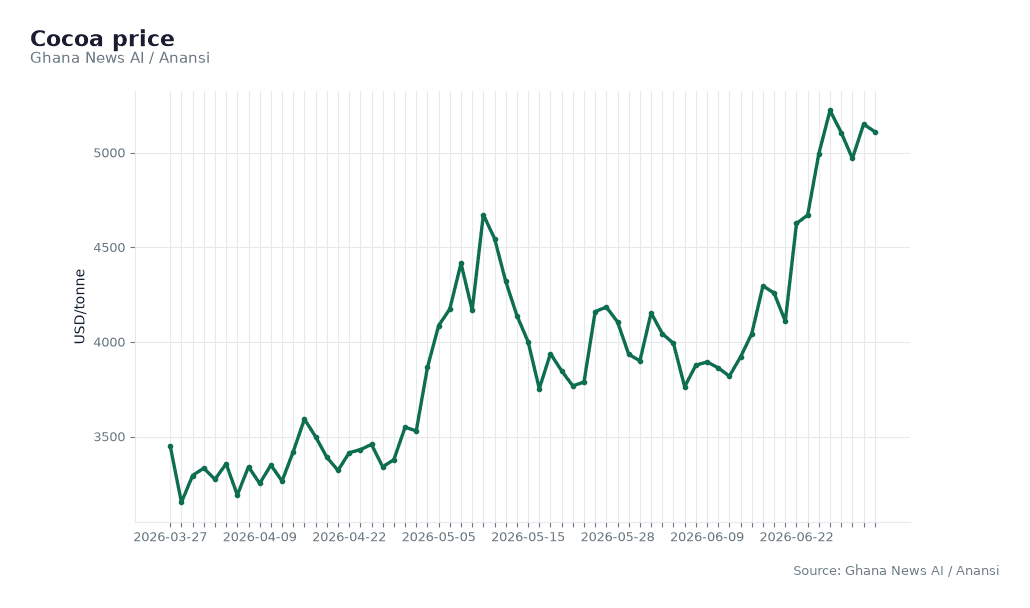
The problem is the ledger's other side, which official gold statistics never capture. The same water bodies being poisoned irrigate the cocoa farms of the Ashanti and Western regions, the backbone of Ghana's agricultural exports. Cocoa traded at $5,111 a tonne at the start of July 2026, down -0.8% from the prior $5,150, according to market data. Every hectare of cocoa land dredged for gold, every river turned to sludge, is a permanent subtraction from that export stream, one that no single season's gold windfall can restore.
Then there is the cost of cleaning the water people must drink. According to Graphic Online and the Ghana Water Company's tariff proposals to the regulator, GWCL's operational costs rose from GH¢4.1 billion in 2023 to GH¢5.5 billion in 2024, and jumped again to GH¢8.1 billion in 2025. Costs are projected to quadruple to GH¢17.7 billion by 2030. The drivers are direct consequences of Galamsey: massive increases in aluminium sulphate and lime needed to treat high-turbidity water, the loss of 40 to 50% of raw water during treatment because of heavy siltation, and repeated shutdowns of treatment plants, such as Kwanyako and eleven others, to repair silt-damaged pumps.
| Indicator | Earlier reading | Later reading |
|---|---|---|
| Gold price (USD/oz) | $4,042 (30 Jun 2026) | $4,100 (1 Jul 2026) |
| Cocoa price (USD/tonne) | $5,150 (30 Jun 2026) | $5,111 (1 Jul 2026) |
| Pra River turbidity | 80–150 NTU (early 2000s normal) | 14,000 NTU peak (Aug 2024) |
| Ankobra River turbidity | 80–150 NTU (early 2000s normal) | 3,720 NTU (2024), 2,920 NTU (2025) |
| GWCL operating cost | GH¢4.1bn (2023) | GH¢8.1bn (2025) |
| Small-scale gold output | 3.4 tonnes (2021) | 103 tonnes (2025) |
The record gold tonnage is real, but so is the destruction of cocoa land, the water treatment bill and the healthcare burden of mercury exposure. Ghana is, in effect, mining down its own natural capital. A rising gold figure is not the same as rising national wealth.
Desperation as a Driver: The Macroeconomic Crisis of 2022-2024
Why do so many Ghanaians risk arrest and poison for a shovel of gravel? The most honest answer is economic desperation, and the timeline makes the link plain. According to research drawing on the Ghana Chamber of Mines, the IMF World Economic Outlook and GoldBod reports, small-scale production actually collapsed between 2018 and 2021, falling from 75.7 tonnes to 3.4 tonnes under the combined weight of a 3% withholding tax and the 2017 ban.
Then the economy broke. Following a 2022 debt default and skyrocketing inflation, which the same research says peaked above 50% in early 2023 before ending 2024 at 23.8%, small-scale production surged by 166%. As prices soared and the cedi depreciated, gold became one of the few assets that held its value and could be turned into cash immediately.
The state itself amplified the pull. According to the research, the surge was driven in part by a "Gold-for-Reserves" programme that used artisanal gold to bolster foreign exchange and stabilise the cedi. In other words, the same downturn that pushed youth toward the pits gave the government a reason to welcome the gold they produced, effectively turning Galamsey into a "survivalist economy" for millions during the crisis.
You cannot arrest your way out of a livelihood problem. When inflation devours wages and the currency loses value by the month, a poisoned river becomes an acceptable price for a young person with no formal job and a family to feed.
The Infrastructure of Illegality: Foreign Capital and Local Power Dynamics
Modern Galamsey is not the work of lone diggers. Excavators and changfan platforms cost far more than a rural labourer can raise, which means the machinery that scaled the crisis had to be financed. Two forces stand out.
The first is foreign capital and expertise, most visibly Chinese. The repatriation figures make the point: according to research on Operation Halt, over 700 foreign nationals were sent home, roughly 70% of them Chinese. Foreign financiers brought both the equipment and the operational know-how to run it, transforming small licensed plots into industrial sites. It is precisely this foreign role that the 2019 amendment to the mining law targeted with mandatory deportation and heavy fines.
The second is local political protection, the network of "godfathers" who shield operations from enforcement. When seized excavators go missing, as the corruption allegations around Operation Vanguard suggest, it points to protection reaching into the machinery of the state itself. Political resistance from local stakeholders was cited among the reasons Vanguard's military component was withdrawn. Without that local cover, the imported machines could not operate in the open for long.
The tragedy is that the people arrested are usually the diggers at the bottom, not the financiers or protectors at the top. Until the capital and the political cover are broken, torching machines simply raises the cost of doing business without ending it.
Investor Sentiment and the Sovereign Brand
For a country that has spent the 2020s rebuilding credibility after a debt default, Galamsey is a reputational liability that reaches well beyond the mining sector. Foreign direct investment now flows through an ESG filter, and environmental, social and governance screens do not look kindly on rivers running 100 to 300 times over their ecological baseline, on forest reserves losing canopy to illegal pits, or on a state of emergency that requires over 4,500 personnel to enforce.
The governance dimension is just as damaging as the environmental one. Missing seized excavators, allegations of political protection and the revolving door of failed operations all read, to an outside allocator of capital, as a rule-of-law problem. A jurisdiction that cannot enforce its own mining law against unlicensed operators raises questions for anyone considering a licensed, long-horizon investment.
There is also a direct fiscal channel. The ballooning cost of treating water, from GH¢4.1 billion in 2023 toward a projected GH¢17.7 billion by 2030 according to the water utility's regulator filings, is a claim on public money that could have funded infrastructure, education or debt service. Investors read rising contingent liabilities as risk.
Remittances and diaspora investment are a vote of confidence in Ghana's future. The Galamsey crisis, and specifically the water it poisons, is a direct threat to the communities that money is meant to support. The environmental story and the investment story are the same story.
Pathways to Formalization: Beyond the Military Approach
If eight years of operations, escalating penalties and a state of emergency have not ended Galamsey, the lesson is not that Ghana needs harsher raids. It is that a livelihood driven by poverty and world gold prices cannot be extinguished by force alone. Durable solutions have to change the economics that pull people toward the pits.
The first pillar is genuine formalisation. The 1989 law began with the right instinct, bringing small miners into a legal framework, before later statutes pivoted to deterrence. A modern version would make licensing fast, cheap and accessible, so that the path of least resistance is the legal one rather than the illegal one. Formalised miners can be trained, monitored and required to rehabilitate land, none of which is possible when the entire sector operates in the shadows.
The second pillar is community-led regularisation and mercury-free technology. Miners who have a legal stake in a plot, and a share in its long-term productivity, have a reason to protect the water and soil around it. Support for equipment that eliminates mercury use would address the most dangerous chemical dimension of the crisis without asking communities to simply stop earning.
The third pillar is structural: alternative livelihoods. The surge in small-scale output tracked the collapse of the wider economy almost exactly, rising 166% as inflation spiked and the cedi fell. That correlation is the whole argument. Restore rural incomes, revive the cocoa economy the mining is destroying, and create formal jobs, and the pull of the pits weakens on its own.
Ghana's dilemma is that the same gold now stabilising its reserves is drawn from the same rivers that sustain its people. Reconciling those two facts, treating Galamsey as an economic and developmental problem rather than only a criminal one, is the only path that breaks the cycle of ban and burn.
The test of any new approach is simple. Do river turbidity levels fall and stay down, and do small-scale miners choose licences over illegality? If the numbers on both move together, Ghana will finally be solving Galamsey rather than fighting it.
Sources: Anansi market data, Ghana News AI newsroom.
Cite us / embed this
Reusing a chart or stat? Please credit Anansi News and link back to this page.
Sources: Anansi market data, Ghana News AI newsroom.
Charts
Sources
- 1.africaindex.com
- 2.unece.org
- 3.goldbod.gov.gh
- 4.myjoyonline.com
- 5.purc.com.gh
- 6.Anansi market data. Gold price
- 7.Anansi market data. Cocoa price
- 8.Ghana News AI. Ghana News AI newsroom coverage